TOP STORIES
CARTOONS
MAGIC MONEY TREE
POSH GRAMMAR
OSBORNE KERCHING!!
PROMISES PROMISES
SOUTHERN FAIL
DUMB POLLSTERS
DON'T BLAME TRUMP!
£13bn APPLE TAX DODGE
SAFE SEATS = BREXIT?
UKIP v LABOUR
ALL OUT OF IT TOGETHER
EU IMMIGRATION
TORY v TORY
PRISON SUICIDES
LONDON LEAVES UK!
EU v TORY MANDATE
HMRC IS A TAX HAVEN
PANAMA TAX LEAK
IDS v IDS
RICH v POOR
POSH BOYS
HELP2BUY PROFITEERS
LLOYDS, RBS CEO PAY
HSBC DRUG MONEY
PM'S MUM FIGHTS CUTS
PEAK "STUFF" IS HERE
HMRC GOOGLY
PENSION TAX RAID

Thursday, 7 January 2016

Thursday, January 07, 2016 Posted by Hari No comments Labels:
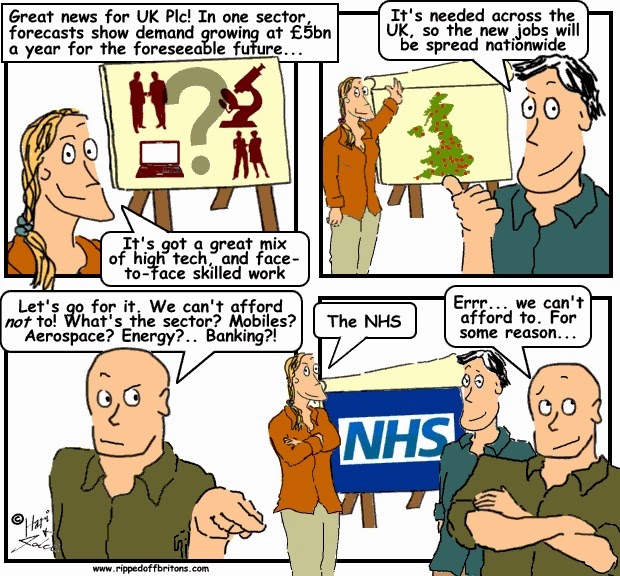
Nurse shortage hits dangerous levels in 90% of hospitals
An analysis by the Health Service Journal (HSJ) of 232 hospitals in England found that 207, or 90%, were unable to meet safe levels during the day, while 81% could not hit targets for night cover and 79% missed both quotas. It marks a decline since January 2015, when 85% of hospitals were short-staffed during the day. Earlier this month the health service missed a series of key targets for A&E waiting times, cancer treatment and ambulance responses, leading experts to warn that the NHS would struggle to cope with the busy winter period. Separate research last week suggested nurses were under such pressure that they could not guarantee safe care for their patients. The Nursing Times survey of almost 1,000 nurses found eight out of 10 were under more stress at work than they were 12 months ago. More than half said they “rarely” or “never” had either sufficient staff or time to ensure safe care for patients, while a third said their ward or team was “always” short-staffed. The chief executive of the Royal College of Nursing, Janet Davies, said the health service was paying the price for previous cutbacks to the nurse training programme. “We went through a period of time when we were trying to save money, we cut posts, we didn’t train enough people and we are still feeling the effect of that,” she said. GUARDIAN

Revealed: how Tory cuts are wrecking UK flood defences
Many of Britain’s flood defences are being abandoned or maintained to minimal levels because of government cuts that could leave almost twice as many households at “significant risk” within 20 years, according to a leaked document submitted to ministers. The Association of Drainage Authorities (ADA), which represents a range of organisations responsible for managing water levels, says in the document: “We have had the five wettest years since 2000. The Environment Agency’s funding for maintaining flood assets has fallen by 14%. Downward adjustments have also been made to intended revenue spending commitments.” Councils had suffered budget cuts of more than 40% since 2010, leaving them with little or no option but to reduce or withhold funding to drainage boards, other organisations and landowners who managed river levels, the document suggests. Referring to the threat to more households as a result of cuts, the experts say: “Annual flood and storm damage costs are approximately £1.1bn, according to the Association of British Insurers, and those households at significant risk [of flood damage] through a reduction in our capacity to manage water levels could increase from 330,000 today to 570,000 in 2035.” It is further proof that ministers were being told before last month’s floods that cuts had left large parts of Britain in greater danger. After much of the north of England and Scotland endured misery over Christmas, ministers had admitted that flood defences were inadequate in many areas, but insisted that extreme weather was to blame, not government cuts. But the experts challenge this view, saying savage reductions to local authority funding had not only had a devastating effect on flood defences but may have added to costs in the long run because the result had been a far faster deterioration than would otherwise have occurred. GUARDIAN

UK commuters spend up to six times as much on rail fares as European passengers
Action for Rail, a campaign by rail unions and the TUC, said some UK workers were spending 13 per cent of their monthly wages on rail travel. By contrast, the average amount of salary going on a monthly season ticket for a similar journey is two per cent in Italy, three per cent in Spain and four per cent in Germany. In France, which is the closest to the UK for cost, commuters still spend nearly a third less on season tickets than their counterparts in the UK, said the report. A survey of more than 1,700 adults for the campaign group found that three out of five believed train services in the UK were poor value for money, with a similar number supporting public ownership.The research was published to highlight protests at more than 60 railway stations by campaigners and rail workers to mark the return to work after the festive break, with fares having increased at the weekend. Aslef general secretary Mick Whelan said: "Taking the railways back into public hands is a popular policy. The vast majority of voters - Conservative included - are fed up with paying sky-high fares so the privatised train companies can take their slice. Commuters travelling into London from Kent and Sussex know their £5,000 a year season tickets would be much cheaper under public ownership." Tickets this year rise by an average of 1.1 per cent in England, Wales and Scotland, affecting 1.7 billion rail journeys made in the UK each year. But the rise means fares have risen at three times the rate of wage pay packets since David Cameron was elected Prime Minister in 2010, according to an analysis by Labour. TELEGRAPH

Five of the largest banks paid no corporation tax in 2014, despite making billions of pounds in profits
JP Morgan, Bank of America Merrill Lynch, Deutsche Bank, Nomura Holdings and Morgan Stanley paid no corporation tax at all. The research into the financial reports found that seven banks, which also included Goldman Sachs and UBS, used tax benefits as well as losses generated during the banking crisis to reduce their corporation tax bills. Unlike some countries, the UK does not have a time limit restricting how long a company can hang on to past losses before using them. The seven banks paid a combined £20m in corporation tax in 2014, even though they had profits of £3.6bn on revenues of £21bn, the news agency said. The banks employed 33,000 staff. The ability of big banks to offset current profits against previous losses was reduced by the government in the 2014 Autumn Statement. In December 2014, Chancellor George Osborne said that the "amount of profit in established banks that can be offset by losses carried forward" would be limited to 50% of their profits in the 2015-16 tax year. Also, from January 2016 banks will have to pay an 8% surcharge on their profits. That is being introduced as an alternative to the Bank Levy on bank balance sheets - first introduced by George Osborne in January 2011 - which is now being cut back over the next six years. But banks were given better news in the 2015 Budget when Mr Osborne said corporation tax was to be cut to 19% in 2017 and 18% in 2020. BBC NEWS

Wednesday, 6 January 2016

Wednesday, January 06, 2016 Posted by Hari No comments Labels: , , , ,
Chris has it all explained by a banker...

SOURCE BBC NEWS: Banking culture inquiry shelved by regulator FCA
The FCA had planned to look at whether pay, promotion or other incentives had contributed to scandals involving banks in the UK and abroad. The Treasury denies involvement in the decision - which some commentators have suggested was politically motivated. Banks around the world have faced huge fines from regulators for their involvement in numerous scandals. In May the news agency Reuters calculated that 20 global banks had paid £152bn in fines and compensation to customers since the 2008 financial crisis. The decision to drop the inquiry comes six months after FCA boss Martin Wheatley - who was originally hired because of his reputation as a tough regulator - was effectively sacked by Mr Osborne following two tumultuous years in the role. Many in the City had found Mr Wheatley's approach too combative and raised concerns about some of the language he used in reference to the banking industry. Percival Stanion, head of multi-asset strategies at Pictet Asset Management, also suggested that it was "no coincidence" that the investigation was being dropped at a time when HSBC was reviewing whether to keep its headquarters in London. HSBC has been a vocal critic of the bank levy, which Mr Osborne reduced in his summer budget following the general election. This will be seen by many as further evidence that regulators and the government have decided to take a softer line with the banks and bring the "banker bashing" era to a close.


OUR RELATED STORIES:

As of 2014, the £20bn paid out by the banks for their PPI mis-selling is more than all their taxes paid since 2008

The bailout of our banks continues. Not from the taxpayer, but from your pathetic savings interest rates. See the BofE data

Financial Reporting Council says just 2% of bank and building society audits are up to scratch

The Interest Rate Swaps that screwed 40,000 small and medium sized businesses: how the regulator allowed the banks to be judge and jury for their own dodgy deals

RBS accused of seizing small business assets and selling them at knock-down prices to an RBS subsidiary

The government wants you to think we made a profit on sale of Lloyds Bank shares. Actually we made a thumping loss!

How re-mortgaging covered up the theft of Britain's growing wealth in the boom, and helped cause the bust


Sunday, 3 January 2016

Sunday, January 03, 2016 Posted by Jake 1 comment Labels: , , , , , , ,

In December 2015 the Financial Conduct Authority (FCA) ditched its Banking Culture Review. In its 2015/16 plan the FCA promised this “Culture Review” of banks stating: 


“In 2015/16 we will conduct a new thematic review on whether culture change programmes in retail and wholesale banks are driving the right behaviour, in particular focusing on remuneration, appraisal and promotion decisions of middle management, as well as how concerns are reported and acted on.” 

A review into whether bankers are Paid, Praised, and Promoted too much for doing the wrong things? And how they treat whistleblowers telling on these wrong things? What's not to like?

Was this FCA U-Turn due to road blocks raised by banking lobbyists and their little helpers in government? Or is it a realisation that the bankers are not responsible for their misdeeds. A realisation that bankers are suffering too, suffering from Affluenza? A realisation that the real cultural problem is actually somewhere else?

“Affluenza” is an affliction brought on by having too much money. The Affluenza Defence pleads that the malefactors have so much money and are so molly-coddled they can’t tell right from wrong. The defence attorney asserts the poor rich things, brought up by weak indulgent guardians, earnestly believe money can make any problem go away. Therefore, having been deprived of a conscience due to this surfeit of cash and lamentable guardianship, the affluenza-afflicted individuals can’t be held responsible for their acts. The fault lies not with the perpetrator, but with the money and the carers.

It is a defence successfully deployed to avoid retribution on both sides of the Atlantic.

In the USA a wealthy youth escaped jail, getting away with probation, having been convicted in a Texas court for a reckless intoxicated (by booze) crash resulting in the deaths of four people. The Guardian newspaper reported:
"During the sentencing phase of Couch’s trial, a defense expert argued that Couch’s wealthy parents coddled him into a sense of irresponsibility – a condition the expert termed “affluenza”. "

In the UK wealthy bankers get away scot free for mischief resulting in a reckless intoxicated (by bonuses) crash that caused The Great Recession. Their fines paid by shareholders (collapsing shareprice and dividends) and customers (higher profit extraction). 

The bankers had been in trouble before this crash and got themselves into trouble again after it, convicted of various frauds and scams including LIBOR frauds, Payment Protection Insurance (PPI) scandals, Interest Rate Swaps Agreements (IRSA) scams, and more. Clearly a deeply ingrained cultural problem. But, following the Affluenza argument, perhaps not among the bankers.

Like spoiled children around the world, the British banking industry has learned by repetition they can get away with anything. Once their guardians have got past all the scolding and finger wagging, they quietly pour water over their reforming zeal, put away their punchy pronouncement, and everyone carries on more or less as before. 

The grim truth is ripping off people is legal in British law. Consumer protection legislation states so long as the ‘average consumer’ is not cheated just about anything goes. The ironically named Office for Fair Trading even provides a helpful flowchart, to ensure even the most weak witted merchant will understand what their ripping-off rights are. In the simplest of terms the flowchart shows the above "average consumer" is protected, the below average is not.  Most things in nature follow the Normal Distribution, which means half the population is 'below average' and so is fair game.
Annotations in RED are by us.
The “Culture Review” of bankers was cancelled not to protect the bankers. It was cancelled to protect the guardians – the regulators, the courts, and the law makers in Parliament. Not because it would expose their powerlessness in the face of bankers' reckless greed and ruthless lobbying, but it would reveal something far worse. It would have revealed to all us ripped-off Britons that the banking culture is absolutely in keeping with the culture in ripped-off Britain.

Sunday, 27 December 2015

Sunday, December 27, 2015 Posted by Jake 6 comments Labels: , , , , , ,
"The profligacy of a man of fashion is looked upon with much less contempt and aversion, than that of a man of meaner condition. In the latter, a single transgression of the rules of temperance and propriety, is commonly more resented, than the constant and avowed contempt of them ever is in the former."   
Adam Smith (1723-1790), free market capitalist icon.

From financial scandals to tax evasion to child abuse we have seen how villains are dealt with according to their stations in life. 

Benefits cheats pinching welfare are publicly stamped on while bankers are treated with extreme lenience for £billions of frauds. Small traders cheating on their VAT returns make it onto HMRC's "most wanted" name and shame list, while the big tax dodgers get sweetheart deals over lunch.

Norman Tebbit, once a leading establishment figure, said of the cover-ups of child abuse by showbiz stars, priests and politicians: "at that time most people felt the establishment was to be protected".


"At that time"? It was thus for hundreds of years before "that time", and it continues to be thus.

Our guest author for this post is the late Adam Smith, capitalist icon, writing over 250 years ago. We start with selected quotes from Smith's essay, in purple for those in a hurry, and then present the full text in blue below:

  • This disposition to admire, and almost to worship, the rich and the powerful, and to despise, or, at least, to neglect persons of poor and mean condition,..is, at the same time, the great and most universal cause of the corruption of our moral sentiments. 
  • That wealth and greatness are often regarded with the respect and admiration which are due only to wisdom and virtue; and that the contempt, of which vice and folly are the only proper objects, is often most unjustly bestowed upon poverty and weakness, has been the complaint of moralists in all ages.
  • We frequently see the respectful attentions of the world more strongly directed towards the rich and the great, than towards the wise and the virtuous.
  • We see frequently the vices and follies of the powerful much less despised than the poverty and weakness of the innocent.
  • The respect which we feel for wisdom and virtue is, no doubt, different from that which we conceive for wealth and greatness...but, in the general air of the countenance, they seem to be so very nearly the same, that inattentive observers are very apt to mistake the one for the other.
  • It is from our disposition to admire, and consequently to imitate, the rich and the great, that they are enabled to set, or to lead what is called the fashion....Even their vices and follies are fashionable; and the greater part of men are proud to imitate and resemble them in the very qualities which dishonour and degrade them. 
  • In many governments the candidates for the highest stations are above the law; and, if they can attain the object of their ambition, they have no fear of being called to account for the means by which they acquired it.  

Smith ends his essay stating the holders of ill-gotten greatness ultimately know what they are, and fear they will be ultimately caught out. Only they know whether this is true or not.


  • the remembrance of what he has done; that remembrance never fails to pursue him. He invokes in vain the dark and dismal powers of forgetfulness and oblivion. He remembers himself what he has done, and that remembrance tells him that other people must likewise remember it. Amidst all the gaudy pomp of the most ostentatious greatness; amidst the venal and vile adulation of the great and of the learned; amidst the more innocent, though more foolish, acclamations of the common people; amidst all the pride of conquest and the triumph of successful war, he is still secretly pursued by the avenging furies of shame and remorse; and, while glory seems to surround him on all sides, he himself, in his own imagination, sees black and foul infamy fast pursuing him, and every moment ready to overtake him from behind.


Full text of Adam Smith's essay:
"This disposition to admire, and almost to worship, the rich and the powerful, and to despise, or, at least, to neglect persons of poor and mean condition, though necessary both to establish and to maintain the distinction of ranks and the order of society, is, at the same time, the great and most universal cause of the corruption of our moral sentiments. That wealth and greatness are often regarded with the respect and admiration which are due only to wisdom and virtue; and that the contempt, of which vice and folly are the only proper objects, is often most unjustly bestowed upon poverty and weakness, has been the complaint of moralists in all ages.

We desire both to be respectable and to be respected. We dread both to be contemptible and to be contemned. But, upon coming into the world, we soon find that wisdom and virtue are by no means the sole objects of respect; nor vice and folly, of contempt. We frequently see the respectful attentions of the world more strongly directed towards the rich and the great, than towards the wise and the virtuous. We see frequently the vices and follies of the powerful much less despised than the poverty and weakness of the innocent. To deserve, to acquire, and to enjoy the respect and admiration of mankind, are the great objects of ambition and emulation. Two different roads are presented to us, equally leading to the attainment of this so much desired object; the one, by the study of wisdom and the practice of virtue; the other, by the acquisition of wealth and greatness. Two different characters are presented to our emulation; the one, of proud ambition and ostentatious avidity. the other, of humble modesty and equitable justice. Two different models, two different pictures, are held out to us, according to which we may fashion our own character and behaviour; the one more gaudy and glittering in its colouring; the other more correct and more exquisitely beautiful in its outline: the one forcing itself upon the notice of every wandering eye; the other, attracting the attention of scarce any body but the most studious and careful observer. They are the wise and the virtuous chiefly, a select, though, I am afraid, but a small party, who are the real and steady admirers of wisdom and virtue. The great mob of mankind are the admirers and worshippers, and, what may seem more extraordinary, most frequently the disinterested admirers and worshippers, of wealth and greatness.

The respect which we feel for wisdom and virtue is, no doubt, different from that which we conceive for wealth and greatness; and it requires no very nice discernment to distinguish the difference. But, notwithstanding this difference, those sentiments bear a very considerable resemblance to one another. In some particular features they are, no doubt, different, but, in the general air of the countenance, they seem to be so very nearly the same, that inattentive observers are very apt to mistake the one for the other.

In equal degrees of merit there is scarce any man who does not respect more the rich and the great, than the poor and the humble. With most men the presumption and vanity of the former are much more admired, than the real and solid merit of the latter. It is scarce agreeable to good morals, or even to good language, perhaps, to say, that mere wealth and greatness, abstracted from merit and virtue, deserve our respect. We must acknowledge, however, that they almost constantly obtain it; and that they may, therefore, be considered as, in some respects, the natural objects of it. Those exalted stations may, no doubt, be completely degraded by vice and folly. But the vice and folly must be very great, before they can operate this complete degradation. The profligacy of a man of fashion is looked upon with much less contempt and aversion, than that of a man of meaner condition. In the latter, a single transgression of the rules of temperance and propriety, is commonly more resented, than the constant and avowed contempt of them ever is in the former.

In the middling and inferior stations of life, the road to virtue and that to fortune, to such fortune, at least, as men in such stations can reasonably expect to acquire, are, happily in most cases, very nearly the same. In all the middling and inferior professions, real and solid professional abilities, joined to prudent, just, firm, and temperate conduct, can very seldom fail of success. Abilities will even sometimes prevail where the conduct is by no means correct. Either habitual imprudence, however, or injustice, or weakness, or profligacy, will always cloud, and sometimes depress altogether, the most splendid professional abilities. Men in the inferior and middling stations of life, besides, can never be great enough to be above the law, which must generally overawe them into some sort of respect for, at least, the more important rules of justice. The success of such people, too, almost always depends upon the favour and good opinion of their neighbours and equals; and without a tolerably regular conduct these can very seldom be obtained. The good old proverb, therefore, That honesty is the best policy, holds, in such situations, almost always perfectly true. In such situations, therefore, we may generally expect a considerable degree of virtue; and, fortunately for the good morals of society, these are the situations of by far the greater part of mankind.

In the superior stations of life the case is unhappily not always the same. In the courts of princes, in the drawing-rooms of the great, where success and preferment depend, not upon the esteem of intelligent and well-informed equals, but upon the fanciful and foolish favour of ignorant, presumptuous, and proud superiors; flattery and falsehood too often prevail over merit and abilities. In such societies the abilities to please, are more regarded than the abilities to serve. In quiet and peaceable times, when the storm is at a distance, the prince, or great man, wishes only to be amused, and is even apt to fancy that he has scarce any occasion for the service of any body, or that those who amuse him are sufficiently able to serve him. The external graces, the frivolous accomplishments of that impertinent and foolish thing called a man of fashion, are commonly more admired than the solid and masculine virtues of a warrior, a statesman, a philosopher, or a legislator. All the great and awful virtues, all the virtues which can fit, either for the council, the senate, or the field, are, by the insolent and insignificant flatterers, who commonly figure the most in such corrupted societies, held in the utmost contempt and derision. When the duke of Sully was called upon by Lewis the Thirteenth, to give his advice in some great emergency, he observed the favourites and courtiers whispering to one another, and smiling at his unfashionable appearance. 'Whenever your majesty's father,' said the old warrior and statesman, 'did me the honour to consult me, he ordered the buffoons of the court to retire into the antechamber.'

It is from our disposition to admire, and consequently to imitate, the rich and the great, that they are enabled to set, or to lead what is called the fashion. Their dress is the fashionable dress; the language of their conversation, the fashionable style; their air and deportment, the fashionable behaviour. Even their vices and follies are fashionable; and the greater part of men are proud to imitate and resemble them in the very qualities which dishonour and degrade them. Vain men often give themselves airs of a fashionable profligacy, which, in their hearts, they do not approve of, and of which, perhaps, they are really not guilty. They desire to be praised for what they themselves do not think praise-worthy, and are ashamed of unfashionable virtues which they sometimes practise in secret, and for which they have secretly some degree of real veneration. There are hypocrites of wealth and greatness, as well as of religion and virtue; and a vain man is as apt to pretend to be what he is not, in the one way, as a cunning man is in the other. He assumes the equipage and splendid way of living of his superiors, without considering that whatever may be praise-worthy in any of these, derives its whole merit and propriety from its suitableness to that situation and fortune which both require and can easily support the expence. Many a poor man places his glory in being thought rich, without considering that the duties (if one may call such follies by so very venerable a name) which that reputation imposes upon him, must soon reduce him to beggary, and render his situation still more unlike that of those whom he admires and imitates, than it had been originally.

To attain to this envied situation, the candidates for fortune too frequently abandon the paths of virtue; for unhappily, the road which leads to the one, and that which leads to the other, lie sometimes in very opposite directions. But the ambitious man flatters himself that, in the splendid situation to which he advances, he will have so many means of commanding the respect and admiration of mankind, and will be enabled to act with such superior propriety and grace, that the lustre of his future conduct will entirely cover, or efface, the foulness of the steps by which he arrived at that elevation. In many governments the candidates for the highest stations are above the law; and, if they can attain the object of their ambition, they have no fear of being called to account for the means by which they acquired it. They often endeavour, therefore, not only by fraud and falsehood, the ordinary and vulgar arts of intrigue and cabal; but sometimes by the perpetration of the most enormous crimes, by murder and assassination, by rebellion and civil war, to supplant and destroy those who oppose or stand in the way of their greatness. They more frequently miscarry than succeed; and commonly gain nothing but the disgraceful punishment which is due to their crimes. But, though they should be so lucky as to attain that wished-for greatness, they are always most miserably disappointed in the happiness which they expect to enjoy in it. It is not ease or pleasure, but always honour, of one kind or another, though frequently an honour very ill understood, that the ambitious man really pursues. But the honour of his exalted station appears, both in his own eyes and in those of other people, polluted and defiled by the baseness of the means through which he rose to it. Though by the profusion of every liberal expence; though by excessive indulgence in every profligate pleasure, the wretched, but usual, resource of ruined characters; though by the hurry of public business, or by the prouder and more dazzling tumult of war, he may endeavour to efface, both from his own memory and from that of other people, the remembrance of what he has done; that remembrance never fails to pursue him. He invokes in vain the dark and dismal powers of forgetfulness and oblivion. He remembers himself what he has done, and that remembrance tells him that other people must likewise remember it. Amidst all the gaudy pomp of the most ostentatious greatness; amidst the venal and vile adulation of the great and of the learned; amidst the more innocent, though more foolish, acclamations of the common people; amidst all the pride of conquest and the triumph of successful war, he is still secretly pursued by the avenging furies of shame and remorse; and, while glory seems to surround him on all sides, he himself, in his own imagination, sees black and foul infamy fast pursuing him, and every moment ready to overtake him from behind. Even the great Caesar, though he had the magnanimity to dismiss his guards, could not dismiss his suspicions. The remembrance of Pharsalia still haunted and pursued him. When, at the request of the senate, he had the generosity to pardon Marcellus, he told that assembly, that he was not unaware of the designs which were carrying on against his life; but that, as he had lived long enough both for nature and for glory, he was contented to die, and therefore despised all conspiracies. He had, perhaps, lived long enough for nature. But the man who felt himself the object of such deadly resentment, from those whose favour he wished to gain, and whom he still wished to consider as his friends, had certainly lived too long for real glory; or for all the happiness which he could ever hope to enjoy in the love and esteem of his equals."

Thursday, 24 December 2015

Thursday, December 24, 2015 Posted by Hari No comments Labels: , , ,

SOURCE DAILY MAIL: Families splashing out on credit cards drives household debt back to pre-crash high of £40BILLION
The shock figures, buried in the latest forecasts by the Office for Budget Responsibility (OBR), reveal that families are set to spend £40 billion more than they earn this year. The OBR, which produces independent forecasts for the Treasury, suggests this figure will soar to almost £50 billion a year by 2020 as consumers carry on spending. After years of austerity, during which time many families cut their spending and paid down their debts, household debt level are now on course to return to record levels. The OBR forecasts that household debt will reach 163 per cent of incomes by 2020 – close to the 168.2 per cent recorded in the first quarter of 2008. Labour, which uncovered the figures, last night said ‘alarm bells should be ringing’. The new figures reveal how households tightened their belts in the wake of the financial crisis. In the depths of the crisis in 2009/10, families spent £67 billion less than they earned as they moved to cut their debts. As the recovery took hold, families gradually started spending again so that by 2013/4, spending exceeded borrowing by £12.4 billion, and has remained in the red ever since. The latest figures also show that interest payments on the debts racked up by families will rise by almost £6 billion a year by 2020 – raising fears about whether some will be able to make repayments.


Saturday, 19 December 2015

Saturday, December 19, 2015 Posted by Jake No comments Labels: , , , , ,

Between 29/10/2015 (9.30am) and 23/11/2015 (11.45pm) the UK Government ran a consultation that “Seeks views on the government’s proposals to set the new mandate to NHS England for this Parliament.”
The conclusions of the consultation were published on the 17th December, the day Parliament started its Christmas Holiday, presumably for avoidance of debate.

Complaints that this important public consultation was being carried out in secret were met by campaigns in particular via the 38 Degree organisation and by an article in the Guardian newspaper on 19th November, four days before the consultation closed. 


Even the Guardian seems to have been caught on the hop, its article stating:
"Jeremy Hunt has been uncharacteristically quiet about the invitation to all of us to comment on the proposed mandate. He made a written statement on the launch day but as far as I could tell, doesn’t seem to have said anything much about it since. I asked the Department of Health how many responses they’d had but they responded that they couldn’t possibly say. I asked NHS England what they think about the mandate and they said: “The mandate is a matter for the Department of Health and the public (via the consultation on it) – we wouldn’t have anything to say on it.” So far, so Kafka."

The result of this alert from 38 Degrees and the Guardian and others was a deluge of public responses. The government's response to the consultation stated that in the two previous consultations there had been a total of about 300 responses, while this time 127,400 responses were received. The government report stated:

“We have consulted publicly twice on the mandate in the past and on both occasions attracted around 300 responses, with slightly more than half originating from members of the public and the rest from institutions of the type described above. This year we attracted a similar number of responses from organisations. The public response, however, was significantly higher than in the past, with around 127,400 responses received by the close of the consultation.”


So what was the consultation about?
“The consultation contained five questions, with free text responses:
1. Do you agree with our aims for the mandate to NHS England?
2. Is there anything else we should be considering in producing the mandate to NHS England?
3. What views do you have on our overarching objective of improving outcomes and reducing health inequalities, including by using new measures of comparative quality for local CCG populations to complement the national outcomes measures in the NHS Outcomes Framework?
4. What views do you have on our priorities for the health and care system?
5. What views do you have on how we set objectives for NHS England to reflect its contribution to achieving our priorities?”


In its own response to the results of the consultation, the government admitted largely ignoring individuals who came as a result of campaigns such as 38 Degrees (they estimate 114,000 people), focussing on the 12,490 "unique" (i.e. not participating as a result of a campaign) contributions. 

However, even excluding these 'campaigners' the public response was overwhelmingly negative to government objectives:


The government report stated:
“The 12,490 'unique' responses not associated with any of the above campaigns consistently raised a number of closely related issues that cut across the consultation questions. The key issues related to funding, private sector involvement and staffing. These, along with our responses, are summarised below.

http://data.worldbank.org/indicator/SH.XPD.TOTL.ZS/countries/1W?display=default

1. Opposition to further private sector involvement in the NHS;
2. Concern that there is insufficient funding to achieve the aims of the mandate and the NHS’s Five Year Forward View;
3. Concern that the mandate does not mention staff, concern over safe staffing levels and a desire to improve pay and conditions;
4. Concern over seven-day services. Qualitative analysis suggested fewer than 3% of responses that mentioned
seven-day services were supportive;
5. Concern over lack of integration, with concerns over funding for public health and social care;
6. Concern that there is insufficient funding to reduce inequalities, and that NHS England does not hold CCGs to account;
7. Very strong support for improving mental health services but concern that there is not enough funding to do so;
8. Strong support for focus on prevention of ill-health, but concerns that public health, community and social care funding is insufficient to achieve aims;
9.Shortness of the consultation period, and lack of publicity.”


This startlingly negative response even from the 'non campaigners' provides food for thought. The Conservative mandate from their 'stunning' electoral victory this year is a smokescreen. The Conservatives won a stunning victory in the 2015 general election. Stunning not because of its magnitude but because it happened at all. The victory left the Tories with the smallest majority in decades. 


And was due not to their own merit but to the success of the SNP in Scotland, and the punishment of the Liberal Democrats everywhere.


If the Tories don't get the message that with an effective campaign, such as conducted by 38 Degrees and the Guardian, the public will turn out to protest at their ideological obsession cutting the public sector, lets hope the opposition parties do. 

And lets hope Great British Voters will exercise their power and turn out to vote come election time.

Thursday, 17 December 2015

Thursday, December 17, 2015 Posted by Hari No comments Labels:
A day at 'the gulag': what it's like to work at Sports Direct's warehouse
Warehouse staff at the group, the booming retail chain controlled by the billionaire Mike Ashley, are required to go through searches at the end of each shift, for which their time is unpaid, while they also suffer harsh deductions from their wage packets for clocking in for a shift just one minute late. The practices contribute to many staff being paid an effective rate of about £6.50 an hour against the statutory rate of £6.70 – potentially saving the FTSE 100 firm millions of pounds a year at the expense of some of the poorest workers in the UK. The discovery of the low pay being received by Sports Direct workers comes on top of a string of criticisms of the working conditions within the retailer’s warehouse in Shirebrook, Derbyshire, where more than 80% of staff are on zero hours contracts. Workers are also: Harangued by tannoy for not working fast enough; Warned they will be sacked if they receive six black marks – or “strikes” (see document below) – over a six-month period for offences including a period of reported sickness, “errors,” excessive/long toilet breaks, using a mobile phone in the warehouse, “time wasting” and “excessive chatting” and “horseplay”; Banned from wearing 802 separate clothing brands at work; The rigorous searches – down to the last layer of clothing, asked to roll up trouser legs and show top of underwear –typically takes 15 minutes, because management is so concerned about potential theft. Meanwhile, local primary schoolteachers have told the Guardian that pupils can remain in school while ill – and return home to empty houses – as parents working at Sports Direct are too frightened to take time off work. Union officers say the strict culture in the warehouse has resulted in workers being afraid to speak out over low pay and conditions as they fear immediately losing their jobs. The criticisms of Sports Direct – which have also included questions about whether its pricing policies are misleading, as well as the influence Ashley has on a company whose shares are held by many UK pension funds – come as the public company continues to dominate the UK sports retailing market and its trading performance flourishes. The retailer’s success story is almost entirely credited to the unconventional retailing nous of Ashley, a self-made man whose fortune amounts to £3.5bn. Zoe Lagadec, a solicitor at Mulberry’s Employment Law Solicitors, said that docking 15 minutes of pay for clocking in slightly late is “arguably a breach of the national minimum wage, which carries both criminal and civil sanctions”. GUARDIAN

That didn't last long! Britons could see pay stagnate AGAIN next year as salary increases slip away
Britain's workers could see their salaries stagnate once more next year as the rate of pay growth falls, a report warns. Annual pay growth could slump to 1 per cent next year if productivity levels fail to increase and inflation rises quicker than expected, the Resolution Foundation said. With inflation expected to pick up slightly from its recent level of around 0 per cent, this would see real wages stagnate again. If current levels of low productivity and prolonged low inflation continue, pay in the UK may not increase to pre-crash levels until the next decade, the report suggests. Laura Gardiner, senior policy analyst at the Resolution Foundation, said: '2015 marked the long-awaited return of rising real pay, following a six-year squeeze, but the recent pay rebound owed much to ultra-low inflation, which we're unlikely to see again next year. Pay growth in 2016 will ultimately be determined by whether the recent upturn in productivity is enough to offset rising inflation. On the upside, strong output growth and prolonged low inflation could result in the highest level of real wage growth in over a decade. But equally, a failure to build on the early signs of a productivity recovery, combined with a swifter-than-expected return to target inflation, could send real wage growth tumbling to less than 1 per cent. Such a scenario could mean typical pay not returning to its pre-crash level until the next decade. There is plenty that businesses and government can do to drive productivity growth. The introduction of the new national living wage should help to focus minds on boosting output, particularly in low-paying sectors who are most affected by the new higher wage floor.' DAILY MAIL

Revealed: how Google enlisted members of US Congress it bankrolled to fight $6bn EU antitrust case
Google enlisted members of the US congress, whose election campaigns it had funded, to pressure the European Union to drop a €6bn antitrust case which threatens to decimate the US tech firm’s business in Europe. Google’s co-founder and CEO Larry Page met the then European commission chief privately in California in spring 2014 and raised the antitrust case despite being warned by EU officials that it would be inappropriate to do so. Google has employed several former EU officials as in-house lobbyists, and has funded European thinktanks and university research favourable to its position as part of its broader campaign. The US House judiciary committee wrote to MEPs concerning the antitrust case against Google. The committee’s chairman, Bob Goodlatte, said the committee was “troubled to learn” some MEPs were “encouraging antitrust enforcement efforts that appear to be motivated by politics” that would ultimately undermine free markets. Google has consistently donated to Goodlatte’s election campaigns, while members on the judiciary committee that he chairs collectively received more than $200,000 (£133,000) from the company during the 2014 election cycle. Google’s expansion of its lobbying activities in Brussels has come in response to a growing number of threats to its business in the EU, where it dominates about 90% of the search market. It argues that its rivals lobby just as hard against it, if not harder. In April, a long-running antitrust investigation came to a head when the newly installed EU competition commissioner, Margrethe Vestager, formally accused Google of abusing its market dominance by systematically favouring its shopping price-comparison service. Under pressure to defend itself, Google has opened its cheque book. Last year, the company spent more than twice as much on lobbying in Brussels than Apple, Facebook, Yahoo, Twitter and Uber combined. Yet Google is still being outspent by Microsoft, which some in Brussels suspect is backing a vocal anti-Google lobby in Brussels. GUARDIAN

Bedroom tax: three in four affected have cut back on food, government research shows
The research found that 46% said they had cut back on heating, 33% on travel and 42% on leisure. Among a control group of tenants unaffected by the bedroom tax, far fewer – 56% – said they were cutting back on food because of benefit changes. The findings by the Cambridge Centre for Housing and Planning Research and Ipsos Mori were slipped out by the government on the last day of parliament before the winter break, along with a deluge of more than 380 other documents. Its study found landlords were very concerned that some tenants were “in severe poverty and unable to pay the shortfall”. The report said 78% of claimants who were still affected by the bedroom tax after two years of the policy were regularly running out of money by the end of the week or month. They tended to pay the rent by using up savings, borrowing from family or friends or accruing debt. The report found that only one in nine claimants escaped the bedroom tax by moving to a different property, and the vast majority of those affected were still affected nine months later. Only 5% of those affected by the policy had been successful in finding extra work, of which half said they were then no longer affected by the bedroom tax. Alison Garnham, chief executive of the Child Poverty Action Group, said:“The DWP’s own evaluation finds that the bedroom tax is not only pushing families into hardship but it’s also failing to free up more accommodation for families – the key argument ministers used to justify this controversial policy.” She also criticised the timing of the report’s publication. “This is a long and deep look at a hugely controversial policy – it really should not have been released just as MPs rise for Christmas,” she said. GUARDIAN

Homeless families in English B&B accommodation rises by 46%
As many as 3,000 families were housed in B&Bs in the three months to the end of September 2015, the figures show. That compares with 2,060 families in such accommodation a year previously, and is the highest total for 12 years. The government announced an extra £5m of help, and said it was committed to helping the most vulnerable in society. Housing charity Shelter blamed cuts in local authority budgets, which have left some councils struggling to cope. There was also a 20% rise in the number of households who were re-housed outside their local area. According to the figures, 18,600 households were re-located, the highest number ever. Almost all of them were in London. The number of children who were in temporary accommodation - and therefore classified as homeless - rose to 103,430 in the quarter, the highest number since 2008. "These figures are a heart-breaking reminder that thousands of families will wake up homeless this Christmas morning - many hidden away in a cramped and dingy B&B or hostel room, sometimes miles away from everyone and everything they know," said Campbell Robb, the chief executive of Shelter. BBC NEWS

Children are being priced out by ‘pay to play’ in public spaces
Until three years ago, south London parents could take their children to Battersea adventure playground to climb, dance and generally let off steam – without paying a penny. Not any more. Last week the treetop adventure company Go Ape opened for business on the site, offering climbing sessions for between £18 and £33 per child. The old adventure playground, which was full of constantly changing equipment painted by the children, has been bulldozed and replaced by an ordinary swings-and-slides park aimed at under-11s. Those using the play park will find themselves looking up at their peers whose parents have paid for them to swing in the treetops. It is likely that there will be more tensions over the use of public space as councils across the country eye up private partnerships. “We’re seeing a lot of parks looking at introducing facilities that generate income,” said Drew Bennellick, head of landscape and natural heritage at the Heritage Lottery Fund. “Whether it’s Go Ape, crazy golf sites, multi-use football facilities that are floodlit, or cafes – they’re all exploring ways to potentially generate income to offset the cost of running the sites.” A report by the fund last year estimated that 45% of local authorities are considering either selling parks and green spaces or transferring their management. GUARDIAN

Osborne gives political adviser 42% rise amid public-sector pay freeze
George Osborne has given the adviser responsible for his new image a promotion and a pay rise of more than 40%, employed an additional seven political aides while asking public-sector workers to accept a pay freeze. Thea Rogers, a close associate of Osborne, received the biggest rise among all the political special advisers across government, with a pay increase of 42%, giving her £98,000. She is now his chief of staff. A former BBC producer who once worked with the corporation’s former political editor Nick Robinson, she is said to have been responsible for Osborne’s Caesar-style haircut and for placing him on the 5:2 diet. James Chapman, the Daily Mail’s former political editor, has been employed this year by Osborne on £125,000, while another Osborne adviser, Sue Beeby, is being paid £73,000 to be part of his Treasury team. Osborne has three other people employed in his office whose pay levels are not registered. A footnote to the data shows that the chancellor has taken on three other politically employed advisers who sit on the council of economic advisers – Richard Davies, who is paid £98,000, Neil O’Brien, who is paid £93,450, and Jennifer Donne, whose pay is not registered. Another adviser to Osborne, Eleanor Wolfson, is currently on maternity leave, the footnote adds. The disclosure comes in data that shows the bill for special advisers (called “spads”) across government has risen to £9.2m in 2014-2015, up from £8.4m over the previous year. At the beginning of this year there were just over 100 spads.  In July, the chancellor told thousands of teachers, nurses, police, firefighters and civil servants that they would face another four-year pay freeze at 1% a year, as part of planned savings worth £17bn. Many more jobs are also set to be lost across the public sector. Under Gordon Brown in 2009-2010 the cost of special advisers was said to be £6.8m, and there were 71 advisers on the government payroll. GUARDIAN

Think tank floats 'basic income' idea for all citizens
The Royal Society for the encouragement of Arts, Manufactures and Commerce (RSA) is recommending a basic universal income. In a new report, the author calls the approach the best alternative "to help people improve their own lives". The RSA estimates that its proposal would cost about an extra 1% of annual national income (GDP). The idea is in principle fairly straightforward: a standard payment is made to every citizen. The report illustrates how it might work using data for taxes and benefits in 2012-2013. The basic income for people aged between 25 and 65 would in this example be £3,692. There is a pension of about double that amount for those older than 65. Anthony Painter, its director of policy and strategy and author of the report, says: "The welfare state has become incredibly complex whilst locking those it seeks to help in a vicious circle of low pay, insecurity and an intrusive state." The potential advantages include simplicity of administration given that you only need to establish that the person receiving it is a citizen. One of the aims of the proposal is to reduce the disincentive to work - or to work more - that comes with the withdrawal of means-tested benefits. As a recipient's income rises, entitlement to most benefits declines and they can be left with only a very small amount of any additional income. It's known as the poverty trap or welfare trap. The RSA's plan picks up an idea that has gained popularity in recent years. Finland is undertaking a pilot scheme, although it will not report its results until 2019.Some cities in the Netherlands are also looking at the idea. There is also a debate in Switzerland about introducing a basic income. In the UK, this idea has been supported by the Green Party. It is also advocated by Sam Bowman of the Adam Smith Institute, a think tank that is not party political but is vigorously pro-free market in its outlook. BBC NEWS

Share This

Follow Us

  • Subscribe via Email

Search Us