TOP STORIES
CARTOONS
MAGIC MONEY TREE
POSH GRAMMAR
OSBORNE KERCHING!!
PROMISES PROMISES
SOUTHERN FAIL
DUMB POLLSTERS
DON'T BLAME TRUMP!
£13bn APPLE TAX DODGE
SAFE SEATS = BREXIT?
UKIP v LABOUR
ALL OUT OF IT TOGETHER
EU IMMIGRATION
TORY v TORY
PRISON SUICIDES
LONDON LEAVES UK!
EU v TORY MANDATE
HMRC IS A TAX HAVEN
PANAMA TAX LEAK
IDS v IDS
RICH v POOR
POSH BOYS
HELP2BUY PROFITEERS
LLOYDS, RBS CEO PAY
HSBC DRUG MONEY
PM'S MUM FIGHTS CUTS
PEAK "STUFF" IS HERE
HMRC GOOGLY
PENSION TAX RAID
Showing posts with label credit crunch. Show all posts

Sunday, 17 July 2016

In his first tweet after being sacked as Chancellor of the Exchequer, George Osborne chirped "Others will judge - I hope I've left the economy in a better state than I found it".

It so happens two weeks earlier the excellent Andy Haldane, executive director at the Bank of England, made his judgement. The date is important, as Osborne was still sitting confidently on his stool in the Treasury, so Haldane wasn't simply knifing a political corpse. Haldane was speaking truth to power, as so many others who should be doing so had long since ceased.

Haldane's speech in June 2016, titled "Whose Recovery?", should be essential reading in particular for the revolting Labour MPs. The speech offers them an insight into why the ordinary Labour Party membership backed Jeremy Corbyn. And why the Labour Party actually is a party of protest, both in Government and in Opposition. 

 
The Golden Rule states "Whoever has the Gold makes the Rules". Whether in Government or in Opposition, the Labour Party should represent those without the Gold, and should act as a counterbalance to those who make the Rules even when it is in Government. Because when the Labour Party was not a party of protest, it became the de facto Tory Party (a.k.a. "New Labour"). In truth, had Tory leaders during the Blair years been brighter they could have more quickly undermined Blair by supporting, not opposing, his policies.

Britain needs strong parties of all complexions, from left to right. Regime change in the Tory Party is done with ruthless corporate efficiency, while in the Labour Party it is done with all the blood and broken noses of a pub brawl. Both methods are fine, so long as both emerge representing their members.

Haldane, a product of state school and redbrick university, whether he is in an oak panelled room or in a whitewashed community centre listens to what he hears and  he sees what he looks at. Listening and seeing are talents sadly missing in the revolting Labour MPs. 

In his speech Haldane says:
"I began by speaking about the UK’s economic recovery.  I never got as far as the improvement in the jobs market or surging confidence.  I was stopped in my tracks by a forest of furrowed brows and a phalanx of probing questions, not all of them gentle.  “What exactly do you mean by recovery?” one asked.  “My charity is dealing with 50% more homeless people than three years ago.”   Every other charity in the room had similar stories to tell.  Whether it was food banks, mental health problems or drug addiction, all of the numbers were up.  The language of “recovery” simply did not fit their facts."

We leave it to Haldane to explain whether Osborne left the economy better than he found it, and why ordinary Labour Party members support Jeremy Corbyn:

1) Haldane points out that the UK economy as a whole can improve by making the rich slightly richer and the poor much poorer:

2) Regional income inequality has widened.
Haldane says:
"Another notable pattern in regional income gains and losses is that the largest gains have come in regions where income was already high – London (incomes more than 30% above the UK average) and the
South-East (14% higher). Contrarily, some of the larger losses have been in regions where income was already-low – Northern Ireland (18% lower than the UK average) and Yorkshire and Humberside (14% lower). Put differently, since the crisis the regional distribution of incomes has widened."


3) In recent years the rich have been given more and the poor have been made poorer. Haldane says: 
"in a subjective well-being sense, there may have been no recovery in the UK over the past few years"

He states:
"aggregate GDP figures may over-state somewhat the impact of the recovery on societal well-being: gains by the already-rich boost well-being by less than equivalent losses by the already-poor. To demonstrate that, Chart 12 plots an illustrative measure of “social welfare”. "
3) The recovery from the 2008 recession has been the slowest in decades:

4) By 2015 GDP per person was only 1% above pre-crash levels.
5) The GDP figure includes all UK income, including that which is sent overseas. Office for National Statistics figures show over half of UK quoted shares are owned by the 'rest of the World'. Illustrating how boosting company profits by holding down wages isn't good for Britons.
% of UK stock market owned by "rest of the World"
Haldane states that in terms of GDP per head that is actually kept in the UK there has been no recovery:

6) The "jobs recovery" has not been a "wages recovery". Noting that more people are in poorer paying jobs, Haldane states: 
"Although the recovery of the past few years has been jobs-rich, it has been notably pay-poor."
Haldane goes on to say:
"This is the longest period of flat or falling wages since at least the middle of the 19th Century". 

7) Bank of England and Office for National Statistics figures for 2015 show that in fact only London and the South East have passed their pre-crash peak. Haldane says:
"For example, in Northern Ireland GDP per head remains 11% below its peak, in Yorkshire and Humberside 6% below and here in Wales 2% below."

8) When it comes to Wealth, Haldane says:
"If we turn from income to wealth, the picture is much the same...This has risen across all regions. But the pattern is again uneven, with the largest gains in London (47%) and the South-East (25%), whereas in Wales the gains are smaller (8%) and in the North East there has been a small fall in wealth. 
"..these gains have come principally from rises in property and pension wealth. In other words, the gains have been skewed towards those in society who own their own home or who have sizable pension pots."

Andy Haldane says in this speech:
"The rising economic tide has not lifted all boats. Indeed, a sizable fraction of households have seen no recovery in their disposable incomes, a rise in job insecurity and at best modest rises in their wealth. For them, the “recovery puzzle” may not be so puzzling. These data also suggest that distributional factors may be important when understanding “whose recovery”. "
 
"This has been an uneven economic recovery, looking across regions, income and age cohorts. Large parts of the UK – many regions, those on lower incomes, the young, renters - have not experienced any meaningful recovery in their incomes or in their wealth."

The revolting Labour MPs desperately hope to cling to their well compensated jobs. The poor things have invested years sucking up to one set of leaders, only to find them chucked out and replaced by Jeremy Corbyn of all people! Probably Corbyn has so little support among the MPs because nobody had bothered licking their spittle onto him.

Labour MPs need to emulate Andy Haldane. Instead of cloaking themselves in self-importance, convinced that only they can "save the Party", they need to go out and see what they look at, and listen to what they hear.  


Labour MPs must stop peeping out of the windows of their Westminster Chambers, demonising their own party members. 

Instead of plotting engrossed in their Westminster mutual admiration society, they need to understand the reasons why Labour Party Members around Britain overwhelmingly supported Jeremy Corbyn.

Monday, 27 June 2016

Labour Party rebels blaming Jeremy Corbyn for BREXIT bring to mind an emotionally inept spouse trying to work out why his angry partner threw a teapot at him

The ninny obsesses about what his spouse had against the smashed teapot. Was it the colour? Did the nozzle drip? Would a new teapot make everything better? He is far too self-obsessed to see the problem is himself.

Labour MPs rebelling against Jeremy Corbyn are so distant and self-obsessed they can’t hear what the people they claim to represent are saying. 


"Blessed are the cheesemakers!" the bovine MPs hear, taking this as clear confirmation they should rebel. "The Greek will inherit the Earth" sends them scurrying looking for whoever is bearing the nicest gifts.

So inept are the Labour rebel leaders that they staged a drip-drip of shadow ministerial resignations over several daysConfirming to ordinary Labour Party members the whole rebellion was rehearsed like a school production of a Gilbert & Sullivan comic opera: long on planning, short on talent.
We Resign, TaranTara!
Or perhaps it was simply the later the resigner left their announcement indicated the measure of their cowardice in waiting for safety in numbers? 

In fact both the main political parties, like many other reptilian species, periodically slough off their skins. The Tories with Thatcher in 1975, and Labour with Blair in 1994. What is unusual is in 2016 the Tories and Labour do it together. Writhing like two mating rat snakes. No romance, no empathy, just the need to spawn and survive.


BREXIT was a protest against a politics that cut the many adrift, leaving the few to prosper. Corbyn and his supporters seem to be the only mainstream leaders who understand this.

Perhaps Corbyn’s role is to block the Labour Leader’s seat to keep it from the Blairistas. Like the ancient Roman Horatio, Corbyn is holding the bridge to the leadership until an ambitious and suitably talented politician emerges from the Left.

Britain needs strong parties of all complexions, from Left to Right. Whoever that ambitious and capable Leftie is, its about time you stepped forward. 

Until then, Corbyn should continue his Rope-A-Dope strategy, and let the rebels come out punching until they get bored with themselves.

Monday, 6 July 2015

Monday, July 06, 2015 Posted by Jake No comments Labels: , , , , , , , ,
If you crashed your mum's car, you would be on your best behaviour for a while until she forgave and forgot. You would do all the good things, washing up and stuff, to reduce her anger and mistrust. So she would lend you her car again when it gets back from the garage with the repair bill for your mum to pay. 

So why, having crashed the World Economy and handing the bill to the World's taxpayers, did the banks carry on regardless with scams like PPI, IRSA, Libor, Forex, aiding tax evasion and money laundering

Didn't they want to assuage their customers' anger and regain their trust?

Actually, data from the Bank of England shows they weren't bothered. 

In July 2015 the Bank of England (BofE) published its biannual "Systemic Risks Survey". This report, produced since 2008, looks into what bankers worry most about. 

The survey works by:
"quantifying and tracking, on a biannual basis, market participants’ perceptions of such risks. The survey covers aggregate risks to the UK financial system, including the probability of a future high-impact event and confidence in the stability of the UK financial system, as well as specific sources of risk which could either have a particularly large impact or be especially challenging to manage as a firm"

The data reveals since 2008 the Financial Services Industry has never been bothered about public anger and mistrust. 


The report identifies 21 specific causes for concern ranging from "Sovereign Risk" to "Cyber Attack". From its first publication "public anger against, or distrust of, financial institutions" ranked lowest or second lowest in twelve of the fourteen reports. Even when banker angst at what their customers thought of them peaked in the first half of 2010 there were only 6 items less important.

On the other hand, the third most scary thing for the finance industry according to the survey is "Risks around regulation/taxes". 


In his Mansion House Speech in June 2015 the Chancellor, George Osborne, dropped a heavy hint that the time for regulatory bashing bankers was coming to an end. Osborne said:"simply ratcheting up ever-larger fines that just penalise shareholders, erode capital reserves and diminish the lending potential of the economy is not, in the end, a long term answer."

This is certainly true. However Osborne goes on to say something that probably isn't true:
"individuals who fraudulently manipulate markets and commit financial crime should be treated like the criminals they are – and they will be."

Taking away the £billions of bonuses (the Office for National Statistics states £87 billion paid to UK Financial Services between 2007 and 2013) pocketed during the bank crash and the associated frauds of the last few years has proved impossible. Doubtless some of these bonuses were fairly earned by earnest bank tellers. And doubtless these bank tellers are used as human shields for the 'bad bankers' who won't have to return anything. 

The Prudential Regulation Authority (PRA, who took over part of the old FSA's job) said in July 2014 the long promised "banker bonus clawback" would come into force for bonuses awarded after January 2015. By June 2015 the PRA for some reason delayed this to January 2016. Giving the bankers an extra year to safely stash their ill-gained swag, and redefine future 'bonuses' as 'allowances' or something else not covered by the clawbacks. 

Christine Lagarde, the head of the IMF, said in May 2014:
"the behavior of the financial sector has not changed fundamentally in a number of dimensions since the crisis. While some changes in behavior are taking place, these are not deep or broad enough. The industry still prizes short-term profit over long-term prudence, today’s bonus over tomorrow’s relationship.

Some prominent firms have even been mired in scandals that violate the most basic ethical norms—LIBOR and foreign exchange rigging, money laundering, illegal foreclosure.

To restore trust, we need a shift toward greater integrity and accountability. We need a stronger and systematic ethical dimension."


Evidence presented to Parliament by IPSOS-Mori shows the depth of public mistrust and support for more regulation in the UK.


To restore trust the bankers need to see trust as something worth restoring, which they evidently don't. To strengthen regulation the government needs to decide who is more important to it, the financial sector or the general public.

Asked which risks would be most challenging to their firms, managing angry customers barely registered at all. Regulation, however, figured highly. 


The government is signalling that the frightened little bankers shouldn't worry for their wallets. Osborne will tuck them up and kiss their fears away. 

Which of course means the rest of should be afraid, very afraid.
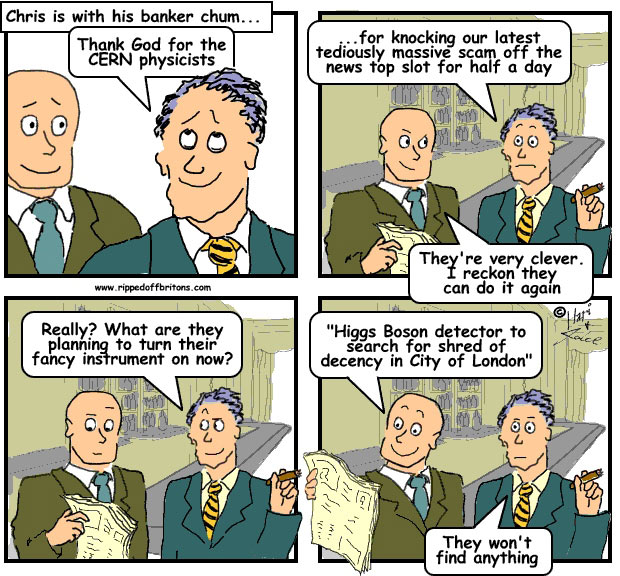
Ripped-off Britons: Cern and the city

Tuesday, 16 June 2015

Tuesday, June 16, 2015 Posted by Hari No comments Labels: , , , , ,

SOURCE CITY AM: Doubts cast on George Osborne over RBS sell-off as Andrew Tyrie questions £14.3bn profit claim
Tory MP Andrew Tyrie, the chairman of the Treasury select committee, cast doubt on chancellor George Osborne’s claims taxpayers stand to make a £14bn profit from the 2008 banking bailout. Osborne unveiled plans on Wednesday to start selling a 79 per cent stake in Royal Bank of Scotland (RBS) – but at a loss to taxpayers who bailed out the bank. Osborne explained, citing a report published by advisory firm Rothschild, that a £7.2bn loss on the sale would be cushioned by a gain made on the sale of other state-owned assets like Lloyds. Overall, Rothschild estimated a £14.3bn surplus for the Treasury from its interventions in the banking sector. But Tyrie said Osborne’s calculation “...would benefit from a great deal of qualification... It excludes the cost of funding the bailouts (£17bn)....And it treats fees paid in exchange for a service as if they were income, or recoveries.” Shares in RBS were at 361.5p yesterday. after the sell-off plans were unveiled. The government would need to sell shares at 407p to break even on its £45bn 2008 recapitalisation of the bank. The first sale of shares is set to come in the next 12 months but could be as soon as September.

“There is another step we take today towards a new settlement with financial services – and that is to get the government out of the business of owning great chunks of the banking system.”
“...if you take into account all the sales we’ve authorised of our bank assets, and the fees we’ve received – at the current valuations taxpayers can expect to make £14 billion more than they paid out. Let me be very clear about what I’m saying tonight: Our economic plan has been about fixing what went wrong in the British economy. So, in the coming months we will begin to sell our stake in RBS.”

Sunday, 14 June 2015

On the 20th May 2015, just weeks after the General Election relieved the Tories of their Liberal Democrat conscience, George Osborne asked the bankers at Rothschild’s to tell him that he should re-privatise RBS (the Royal Bank of Scotland). 

Accordingly Rothschild’s produced a report titled “The UK investment in the Royal Bank of Scotland”. The report says the government should indeed re-privatise RBS. To cover their expensively pinstriped backsides Rothschild's started the report with a disclaimer which included statements such as:
"The Report has been prepared on the basis of publicly available information. This information has not been independently verified by Rothschild....no responsibility or liability is or will be accepted by Rothschild or by any of their officers, servants, agents or affiliates as to or in relation to the accuracy or completeness of the information forming the basis of this Report"

In short, Rothschild's stated: we took the information we were given; we didn't check whether it was correct; we didn't check whether it was complete; don't blame us if it is wrong.

The report managed to assert that we, the British taxpayers, not only get our money back but we make a £14.3 billion profit! The report concedes that we made a loss from RBS alone, estimated at £7.2 billion. But taking into account all the financial sector crash rescues together: RBS, Lloyds, UKAR (i.e. the remains of Northern Rock and Bradford & Bingley) and various other unspecified institutions the report claims an overall surplus of £14.3 billion. 


To see if this is true, we took a look at publicly available information from the National Audit Office (NAO).
 
1) "Cash and fees received"
Consider in the Rothschild's table above, Shaded in purple, the "Cash and fees received" and the "CGS fees" and "SLS fees":
The Rothschild's report states “We also take into account the fees received by the government under the Credit Guarantee Scheme and Special Liquidity Scheme (industry-wide funding and guarantee schemes) under which there is no remaining liability to the taxpayer and no payments were made.”

What's this about? The banks bought £1.029 trillion (equal to 80% of all publicly owned wealth put together: £1.34 trillion in 2013-14) of insurance cover from the government to protect them against further losses. This insurance came mainly in the form of the Credit Guarantee Scheme, the Special Liquidity Scheme, and the Asset Protection Scheme

The banks didn't claim on this insurance, so Rothschild's decided they would use the premium to put against the amount the banks owed the government. You try going to your insurer and see what they say if you ask for your premiums back because you didn't make a claim. And you want the money to pay off your overdraft.


Also included in this "cash received" is interest paid by the banks on £133 billion in loans the government gave them. (This £133 billion is not included in the "Amount Injected" figures in the table above).

[Text in purple and red below is taken from the National Audit Office].


There were two types of support provided:

  • Provision of guarantees and other non-cash support. The main items under this heading are the Credit Guarantee Scheme, Special Liquidity Scheme and Asset Protection Scheme, as well as various other guarantees and indemnities provided to UK banks.

  • Provision of cash in the form of loans to the Financial Services Compensation Scheme and insolvent banks to support deposits, and the purchase of share capital in Royal Bank of Scotland and Lloyds Banking Group.

Peak Support
  • Guarantee commitments [insurance]: £1.029 trillion
  • Cash outlay [loans]: £133 billion
  • Total Peak Support: £1.162 trillion

The National Audit Office states that this £17 billion in cash and fees received by the government is actually less than the cost to the government of providing the support. For Rothschild's to include this to show the taxpayer made an overall profit is nonsense. The sort of blinkered accounting that got the banks into the Credit Crisis in the first place. The NAO explicitly states the taxpayer made a loss:

  • The fees and income received. As at 31 March 2014, the Treasury had received a total of around £17 billion in fees and interest for providing the support and assuming the risks covered by the guarantees since 2008. This is below the cumulative finance cost.

2) "Outstanding Payments"
Shaded in green in the Rothschild's table above, "Outstanding Payment" refers to £20.3 billion still owed by the banks to the government. For example RBS owed £1.2 billion to buy back the government's right to the lion's share of dividends, their "Dividend Access Share". Something RBS is keen to do so it can restart paying dividends, which haven't been paid since its rescue by the government.


Rothschild's assumes this £20.3 billion will all be payed back. Taken literally one can't argue with this. If the banks decide they don't have the money, then the taxpayers will bail them out. The taxpayer picking up these banks' debts to the taxpayer would actually be relatively small beer in the grand scale of things the taxpayer has been picking up for the financial sector.

3) Loss due to government's cost of borrowing
Something Rothschild's have completely omitted is the government had to borrow the money used to bail out the banks. 

Odd that bankers never forget about the interest when we borrow from them, but it completely slips their minds when they borrow from us.

The National Audit Office states the government paid a bit under 3% interest on the money it borrowed to bail out the financial services industry:

"Costs arising from the additional government borrowing raised to finance the purchase of the shares and loans.. The money needed to make the interventions was provided by longer-term funding in the form of Gilts (interest-bearing government bonds purchased by investors for periods of up to 50 years), at a cost of just under 3% a year."

During past sales of Lloyds Bank shares George Osborne claimed to be making a profit by comparing the sale price with the original bailout purchase price. He pulls this off by ignoring the 3% interest cost to the government. The reality is all these Lloyds share sales were made at a considerable loss:


Taking this 3% interest into account, we can see the real loss the British taxpayer has made in what Rothschild's describes as its "investment in the Royal Bank of Scotland":

4) The Opportunity Cost:
The Opportunity Cost represents what may have been gained if the government used the money given to bailout the banks on something else. 

The National Audit Office stated,
"The income generated by fees and interest is less than would be expected from a normal market investment and has not compensated the taxpayer for the degree of risk accepted by taxpayers in providing the support. Once the opportunity cost and risks are factored in, the schemes have represented a transfer from taxpayers to the financial sector."

For example, what if the government had built houses in Greater London to relieve the "housing crisis"? Using the Halifax House Price Index for Greater London, we can see how much more was lost for not doing the things we could have done:

It is ironic that the chancellor asked the bankers at N.M.Rothschild's to advise him. About 200 years ago an earlier head of the bank, a chap called N.M.Rothschild, said "Buy when there is blood in the streets". His meaning was to buy cheap when everyone else is panicking, so you can sell at a healthy profit later when everyone has calmed down. Instead, Osborne has decided to sell RBS at a loss. 

It is clear from the National Audit Office that the UK Taxpayer has made a large loss on the bailouts overall. 

But let's consider RBS alone. To estimate how big a loss the taxpayer investment in RBS actually is, as at 5th June 2015 (the date for which figures in the Rothschild's report are done):

[Figures in Rothschild's report are in blue; figures that didn't make it into the report are in purple; figures included in the report that shouldn't be, the bogus "cash and fees", are in green]
  • Amount injected between Dec2008 and Dec2009: £45.8 billion
  • Government paid interest on this £45.8 billion at 3% for 6 years: £8.2 billion in interest
  • "Cash and fees" from Rothschild's report £4.5 billion not included in the 'surplus'
  • Value of RBS shares stated in Rothschild's report: £32.4 billion 
  • Loss stated in Rothschild's report: £7.2 billion
  • Actual loss = £7.2b + £4.5b + £8.2b = £19.9 billion

It was perhaps inevitable that the big winners from the banking crash would be the banking sector. RBS, we are told, will thrive under private ownership because it will be able to do things it can't do under public ownership. 

We shudder to think what those things are, having already experienced Payment Protection Insurance, Interest Rate Swap Agreements, and various other scams pulled off by privately held banks in recent years.

And so here we are again. The taxpayers, having rescued and sheltered the collapsed banks, now release them back into the wild private sector, where we can continue to be their victims in the various shenanigans that are known collectively as "banking". 


Sadly there is nothing much we can do about that. But one thing we can do: when they tell you we British taxpayers made a profit from the banking bailouts take advice not from Rothschild's report but from Tom the cartoon cat: "Don't you believe it!"


Sunday, 18 January 2015

Sunday, January 18, 2015 Posted by Jake 3 comments Labels: , , , , , ,

In a bakery not far away there was a baker, who treated his customers extremely unequally. To some he gave plain buns, others spiced buns with candied fruit, and to others iced buns. He said the bankers worked harder than the nurses, and so deserved the icing. And the accountants were cleverer than the teachers but didn't work as hard as the bankers, so they deserved the candied fruit buns. Iced buns are much better than plain buns, inequality was very great.

One day the icing machine crashed, due to a leak in the water pipes leading it to flood. With no icing there were no iced buns. The bankers could only get the spiced variety. Now spiced buns are better than plain buns, but less so than iced buns. Inadvertently, inequality was reduced! At least until the icing machine got bailed out.

The Tories are claiming that inequality has reduced since 2010. They are correct. Since the banker induced crash that started in 2007/08 the incomes of the top 20%, as shown by this graph from the ONS, fell more sharply than everyone else. 

As the rewards of the boom years weren't shared with those on low income, like the icing on the buns, they didn't see so much downside on income when the economic machine broke. Thus the Tories can say 'inequality' has fallen.


The standard measure of inequality is the GINI Coefficient, which looks at income but not at wealth. So the Tories are correct: income inequality, GINI, did fall marginally in the years immediately after 2010.


On the other hand, since the banking crash and the policy of QE (Quantitive Easing) asset prices have grown strongly. The BBC provide a 1 minute explanation of what QE is:


Those left wing firebrands at the Financial Times provide another useful primer on the effect of QE:


The speaker, Professor John Kay of the London School of Economics, states among other things that the policy of Quantitative Easing is like:

  • “pouring water into a leaking pipe in the hope that some might dribble through"
  • “those who have assets [including home owners & shareholders] benefit in relation to those who don't"


According to a report by Credit Suisse, in 2013-14 household wealth has done extremely well, with a close to 20% increase:


A 20% increase in assets helps those with most assets the most, and those with no assets not at all. In relation to its £325 billion of QE, the Bank of England's report states:

"the total increase in household wealth stemming from the Bank’s £325 billion of asset purchases up to May 2012 of just over £600 billion... In practice, the benefits from these wealth effects will accrue to those households holding most financial assets."

The Office for National Statistics "Total Wealth In Great Britain, 2010-2012" report shows how all wealth (Financial; Property; Physical; Pension) is distributed. You will notice that the bottom 50% have virtually no Financial Assets:


A report by Ed Conway of SkyNews, estimates how much each decile (the '10th' in the graph below is the wealthiest 10% etc) benefited from QE by 2012:Source: Sky/Bank of England/Office for National Statistics

A billionaire hedge-fund manager in the USA, Stanley Druckenmiller, commented about the US policy of Quantitive Easing:

"This is the biggest redistribution of wealth from the middle class and the poor to the rich ever."

So, in answer to the question "has inequality reduced since the Conservative-LibDem government of 2010", the answer is:

Income: Yes, a little bit.  
Wealth: Hell no!

Share This

Follow Us

  • Subscribe via Email

Search Us