TOP STORIES
CARTOONS
MAGIC MONEY TREE
POSH GRAMMAR
OSBORNE KERCHING!!
PROMISES PROMISES
SOUTHERN FAIL
DUMB POLLSTERS
DON'T BLAME TRUMP!
£13bn APPLE TAX DODGE
SAFE SEATS = BREXIT?
UKIP v LABOUR
ALL OUT OF IT TOGETHER
EU IMMIGRATION
TORY v TORY
PRISON SUICIDES
LONDON LEAVES UK!
EU v TORY MANDATE
HMRC IS A TAX HAVEN
PANAMA TAX LEAK
IDS v IDS
RICH v POOR
POSH BOYS
HELP2BUY PROFITEERS
LLOYDS, RBS CEO PAY
HSBC DRUG MONEY
PM'S MUM FIGHTS CUTS
PEAK "STUFF" IS HERE
HMRC GOOGLY
PENSION TAX RAID

Sunday, 30 October 2011

Sunday, October 30, 2011 Posted by Jake No comments Labels:

Some of the most valuable insights on the Ripped-Off Britons blog have been sourced from insiders and professional observers of our subjects. A few of these insiders and observers have themselves made valuable written contributions to the blog:


Richard Murphy, loved and loathed as one of Britain's most effective campaigners against tax abuses by powerful companies, individuals, and the government, gives us his checklist for 'good capitalism'.


Stefan Stern, visiting professor at the Cass Business School, asks why Truth in public life has gone even more out of fashion.


Deborah Hargreaves, Chair of the High Pay Commission, wrote on the de-linkage of executive pay from performance and how this is resulting in gaping and growing inequality. In a later article, she explains why this is not just morally dubious, but is also against the national interest.


Alexandra Woodsworth, of Campaign for Better Transport, described how Britons are among the most ripped-off in Europe when it comes to rail fares. She tells that the government will be raising the cap of fare rises from 1% to 3% above RPI, and how this will price people off the trains - a cynical ploy to reduce overcrowding? Sophie Allain, also from Campaign for Better Transport, wrote on the fact that Britons can pay three and a half times more than the fare for an equivalent journey in Europe.


"Honestly Banking", a banker writing undercover on his own blog, wrote a piece exposing the churning tactic used by fund managers to drive up their fees at your cost. He tells how new financial legislation has actually removed the requirement for funds to report their portfolio turnover!


If you have a good story you would like to tell on our blog, particularly if you are an insider, please contact us at guestblog@rippedoffbritons.com


One way to try and stay out of trouble is to write your piece as "factual fiction",  or "faction". Write as an imagined employee of the Ripped-Off Britons group of companies:


ROB Bank - perhaps you have an insight on the orders and incentives and threats from HQ on selling?


ROB Insurance - for example, do you know the rate at which claims are incurred and paid? And therefore can you identify an insurance product that is sold that few people successfully make claims on - e.g. Payment Protection Insurance, Indentity Fraud Insurance.


ROB Supermarket - do you know why a top supermarket prices some loose fruit & veg per kilo and bagged fruit & veg per pound? Could it be to confuse? Surely not.


ROB Telecom -
ROB Gas & Electricity -
ROB you name it...


These are just examples of topics you may want to write about. Organisations in Britain have vast armies of people, and pour treasure chests of money into campaigns to rip us Britons off. So we know there are many many other topics to be written about.


Articles need to be evidence based. Your comments should be backed up by graphs, data, quotations etc. from recognised researchers and commentators.

Please contact us with an outline of your proposed article - email us at guestblog@rippedoffbritons.com


If, like "honestly banking", you wish to remain anonymous then we'll accommodate you. Or if, like the High Pay Commission and Campaign for Better Transport, you want links to your own sites and blogs then that will be an honour for us too.

Friday, 28 October 2011

Chris and KJ have pretty strong opinions on certain people

Wednesday, 26 October 2011

Wednesday, October 26, 2011 Posted by Hari No comments Labels: , , , , , , , ,
Chris and his wife try and find the best bargains while shopping in a supermarket

Sunday, 23 October 2011

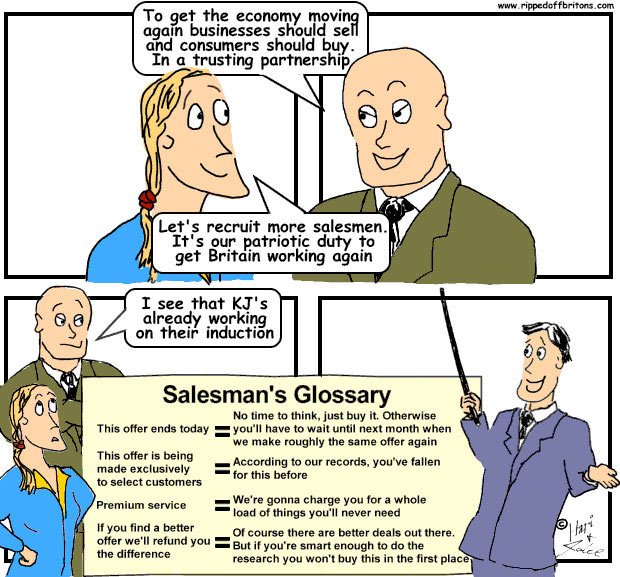
Ripped-off Britons: Sales speak explainedThe right to rip-off Britons is enshrined in British law, most explicitly by the ironically named Consumer Protection from Unfair Trading Regulations”. It is not our contention that the rip-offs we write about in this blog are illegal – just that they are rip-offs. But that is the problem: as you will read in the rest of this blog, the rip-offs are not in breach of the Consumer Protection from Unfair Trading Regulations so long as they rip-off no more than half their target market.


The preamble in this legislation tells us that the law will protect the “average consumer” (and of course all those smarter or better informed than average). It helpfully goes on to qualify this “average consumer” as being “reasonably well informed, reasonably observant and circumspect”.


It further states that:
“In determining the effect of a commercial practice on the average consumer where the practice is directed to a particular group of consumers, a reference to the average consumer shall be read as referring to the average member of that group.”

...going on to say:

“(a) where a clearly identifiable group of consumers is particularly vulnerable to the practice or the underlying product because of their mental or physical infirmity, age or credulity in a way which the trader could reasonably be expected to foresee,

and


(b) where the practice is likely to materially distort the economic behaviour only of that group,

a reference to the average consumer shall be read as referring to the average member of that group”

Thus, in words comprehensible to the average trader, the legislation makes clear that the trader is permitted to rip off the "below average" half of the population. If the trader, be he a high-street banker or a purveyor of sweeties, is selling specifically to a mentally infirm or credulous group then he is permitted to rip off the more infirm and credulous half of the group.

The act goes on to stipulate explicitly what a trader may and may not do:

  • A commercial practice is unfair if…..it materially distorts or is likely to materially distort the economic behaviour of the average consumer with regard to the product. 
  • A commercial practice is a misleading action if…. it causes or is likely to cause the average consumer to take a transactional decision he would not have taken otherwise. 
  • A commercial practice is a misleading omission if, in its factual context…. it causes or is likely to cause the average consumer to take a transactional decision he would not have taken otherwise. 
  • A commercial practice is aggressive if….it significantly impairs or is likely significantly to impair the average consumer’s freedom of choice or conduct in relation to the product concerned through the use of harassment, coercion or undue influence


The act continues that a trader is guilty of an offence if:
  • (a) he knowingly or recklessly engages in a commercial practice which contravenes the requirements of professional diligence under regulation 3(3)(a);
and
  • (b) the practice materially distorts or is likely to materially distort the economic behaviour of the average consumer with regard to the product under regulation 3(3)(b).

Never underestimate the power of an “and”. Einstein, in one of his quips about the world we live in, thought compound interest was the most powerful force in the universe. I think it is “and”, and/or perhaps “or”. Two little words that make almost anything possible. In this case the “and” tells us that the trader is legally allowed to use any tactic he wants, be it unfair, misleading, aggressive, reckless, unprofessional so long as the “average consumer” won’t be tricked by them. Anyone “less than average” is fair game to be recklessly coerced, misled, and handled unfairly. On them it’s open season 12 months a year!


To understand the implications of the legislation:

Friday, 21 October 2011

Friday, October 21, 2011 Posted by Hari No comments Labels: , , , ,
KJ and his pal have a drink while they discuss pensions and debt. But who's paying?

Wednesday, 19 October 2011

Wednesday, October 19, 2011 Posted by Jake 7 comments Labels: , , , ,
Another addition to our LiebraryIn October 2011 OFGEM reported that energy companies' profit margins had leaped from an average £15 to £125 per dual-fuel customer per year. They claim that this equates to a 9% margin.

The industry claims that this margin is a reasonable return on their costs. The reality is that over 50% of what they charge is down to the commodity cost of the fuel plus the VAT.

This 50% for commodity and tax is just a pass-through cost. The retailer buys it from the wholesaler, and delivers it unchanged to your house.

It is no more legitimate for an energy retailer to fiddle down its profit margin calculation in this way than it would be for the post-office to include the value of the contents of the packages it delivers in its turnover.

Therefore the real margin based on the cost of delivery is actually double 9%,  coming in at a gouging 18%.


Graph from OFGEM Supply Market Report of June2011.


Tuesday, 18 October 2011

Tuesday, October 18, 2011 Posted by Hari No comments Labels: , , , ,
The gang debate David Cameron's call for action from the big six energy suppliers

Tuesday, October 18, 2011 Posted by Jake 9 comments Labels: , , , , , , , ,
Another addition to our Liebrary: How is it that our leaders, including the well coiffed Cameron and the buff Huhne, are so poorly briefed about wholesale energy prices? 

So poorly briefed that Cameron and Huhne went to a high profile showdown to 'get tough' with the Big Six energy companies and come away mesmerised by the idea that retail prices are driven up by wholesale prices? Coming away preaching that the solution is for us all to wrap up warmly and search the internet for a lower tariff:


Graphs from Consumer Focus, the soon to be axed "statutory consumer champion for England, Wales, Scotland and (for postal consumers) Northern Ireland", show the truth.

Wholesale prices have indeed risen in recent months. But that follows an even bigger fall in the months before that. Which all left wholesale prices well below their 2008 peak.  

On the other hand, the average retail price rose with the peak in 2008,  failed to fall as wholesale prices plummeted throughout 2009, and now starts rising even above the 2008 peak.

Electricity Prices - Wholesale vs Retail (graph from Consumer Focus, updated upto 2014)
Wholesale v retail electricity
Gas prices - Wholesale vs Retail (graph from Consumer Focus, updated upto 2014. Consumer Focus commented "For the second time in the last few years, average consumption levels for both fuels were revised downwards in late 2013 by Ofgem. This accounts for the “fall” in the retail gas price despite all suppliers putting their unit prices up.")
Wholesale v retail gas
See the full Consumer Focus article - click here [NOTE: The government closed down Consumer Futures as of 1st April 2014. As far as we can tell, this graph is no longer maintained]

Sunday, 16 October 2011

David Cameron, prime minister of the UK, when speechifying about the cuts claims that we are “all in this together”. We must all, he insists, make sacrifices to pull the British economy out of the crash. A mantra repeated by leaders around the world to explain the all the sackings and the cuts. And to defend the additional money being poured into the banks even today as the Euro crisis rumbles on. All done, we are told, to save us all who are, it is stated, in it together.

Of course the assertion that 'we are all in this together' is a lie. The way we keep the economic balloon afloat is to chuck some people out of the basket. In the words of the Governor of the Bank of England, Mervyn King:

Mervyn King, Governor of the Bank of England, in evidence to the UK Parliament’s Treasury Select Committee, March 2011.

The people thrown out of the basket are absolutely not the ones who caused the current economic crisis. 

We are absolutely not all in this together. According to latest ONS figures for October 2011 the current crisis with 2.57 million Britons out of work leaves 29.1 million employed. Tragedy for the unemployed, some of whom may never re-enter work. But a great opportunity for those who still have a salary to draw, as dropping demand brings out a slew of bargains in shops and holiday destinations. A great opportunity to get a wider flat-screen tv, renew the sofa, and take a bargain-break to Marrakech for a new rug. And with more people unable to pay their mortgages, perhaps a chance to pick up a bargain home!

The Independent Commission on Banking published its final report last month, and then closed itself down. The report has various interesting elements, to which we shall return in a future blog. But these two graphs we need to look at now.

The first shows how the banks leveraged themselves – i.e. borrowed lots of money – to fund their irrational exuberance leading to the worldwide economic crash. Banks made money and paid bonuses by doing deals. The quality of the deal was irrelevant – all that mattered was the banks’ fees and the resulting bonuses. Be it an over-stretched “sub prime” home-buyer or a fiscally incompetent government doing the borrowing. To do the deals the banks needed money which they borrowed often from each other, generating further fees for themselves. The deal made the commission that paid the bankers’ bonuses.

The second graph shows public sector debt with and without “Interventions”. “Interventions” being the money pumped into the banks to make sure that when all the rotten deals imploded the banks could pay their debts using taxpayers’ money. To bail out the banks, Britain’s national debt nearly quadrupled.  


The banks who did cause the financial crisis are already reaping profits and bonuses, as is shown in this Bank of England graph from their 2010 Financial Stability Report. The graph shows that banks will be back to their pre-crash levels of profits this year even as the rest of us pay the price of what they caused.


So who is paying the price? The National Association of Welfare Rights Advisers, details the impact on the poorest. Some of the highlights include:

Friday, 14 October 2011

Friday, October 14, 2011 Posted by Hari No comments Labels: , , ,
KJ's feeling the squeeze so decides to rent out another room

Share This

Follow Us

  • Subscribe via Email

Search Us