TOP STORIES
CARTOONS
MAGIC MONEY TREE
POSH GRAMMAR
OSBORNE KERCHING!!
PROMISES PROMISES
SOUTHERN FAIL
DUMB POLLSTERS
DON'T BLAME TRUMP!
£13bn APPLE TAX DODGE
SAFE SEATS = BREXIT?
UKIP v LABOUR
ALL OUT OF IT TOGETHER
EU IMMIGRATION
TORY v TORY
PRISON SUICIDES
LONDON LEAVES UK!
EU v TORY MANDATE
HMRC IS A TAX HAVEN
PANAMA TAX LEAK
IDS v IDS
RICH v POOR
POSH BOYS
HELP2BUY PROFITEERS
LLOYDS, RBS CEO PAY
HSBC DRUG MONEY
PM'S MUM FIGHTS CUTS
PEAK "STUFF" IS HERE
HMRC GOOGLY
PENSION TAX RAID
Showing posts with label FCA. Show all posts

Friday, 19 February 2016

Friday, February 19, 2016 Posted by Hari 1 comment Labels: , , , ,
KJ and Fee explain...

SOURCE GUARDIAN: HSBC to keep its headquarters in London, after concessions from chancellor
HSBC is to keep its headquarters in the UK after a 10-month review during which time the government has made a series of changes regarded as favourable to the bank. After the May 2015 Conservative election victory the chancellor, George Osborne, has backed away from creating rules intended to toughen up the regime for holding senior bankers to account. He had said he would reverse the burden of proof but has reverted to the more usual system of bankers guilt having to be proven. He also changed the system for taxing banks. A bank levy on balance sheets, which hit HSBC hardest of all the banks, is being scaled back and an eight percentage point corporation tax surcharge on profits is regarded as hitting its smaller rivals harder. Analysts have calculated that the changes mean HSBC will pay £300m to the exchequer – down from £1bn under the previous bank levy system. 

SOURCE BLOOMBERG: HSBC sued over drug cartel murders after laundering probe
Families of U.S. citizens murdered by drug gangs in Mexico have sued HSBC, claiming the bank can be held responsible for the deaths because it let cartels launder billions of dollars to operate their businesses. The lawsuit brings fresh scrutiny to the Mexican activities of HSBC, which in 2012 paid $1.9 billion to resolve a criminal investigation into whether it violated U.S. sanctions laws and laundered at least $881 million on behalf of drug cartels. The new case recounts a series of murders in 2010 and 2011 in horrific detail, arguing that the bank should be held to account for them under the U.S. Anti-Terrorism Act. Lesley Redelfs was four months pregnant when she and her husband, Arthur, were shot by the Juarez cartel after leaving a children’s birthday party hosted by the U.S. Consulate in Ciudad Juarez, where she worked. Jaime Zapata and Victor Avila Jr. were special agents for Immigration and Customs Enforcement, driving to Mexico City when they were run off the road by two vehicles filled with hit men from the Los Zetas cartel, who then opened fire. Avila survived. Rafael Morales Jr. was abducted on his wedding day, as were his brother and uncle, and the three died of asphyxiation after members of the Sinaloa cartel wrapped duct tape around their heads. HSBC already is among banks facing a lawsuit from families of U.S. soldiers killed or injured by attacks in Iraq on accusations that the firms helped Iran process transfers and finance Hezbollah and other militant groups. 


OUR RELATED STORIES:

As of 2014, the £20bn paid out by the banks for their PPI mis-selling is more than all their taxes paid since 2008

The bailout of our banks continues. Not from the taxpayer, but from your pathetic savings interest rates. See the BofE data

Financial Reporting Council says just 2% of bank and building society audits are up to scratch

The Interest Rate Swaps that screwed 40,000 small and medium sized businesses: how the regulator allowed the banks to be judge and jury for their own dodgy deals

RBS accused of seizing small business assets and selling them at knock-down prices to an RBS subsidiary

The government wants you to think we made a profit on sale of Lloyds Bank shares. Actually we made a thumping loss!

How re-mortgaging covered up the theft of Britain's growing wealth in the boom, and helped cause the bust

Wednesday, 6 January 2016

Wednesday, January 06, 2016 Posted by Hari No comments Labels: , , , ,
Chris has it all explained by a banker...

SOURCE BBC NEWS: Banking culture inquiry shelved by regulator FCA
The FCA had planned to look at whether pay, promotion or other incentives had contributed to scandals involving banks in the UK and abroad. The Treasury denies involvement in the decision - which some commentators have suggested was politically motivated. Banks around the world have faced huge fines from regulators for their involvement in numerous scandals. In May the news agency Reuters calculated that 20 global banks had paid £152bn in fines and compensation to customers since the 2008 financial crisis. The decision to drop the inquiry comes six months after FCA boss Martin Wheatley - who was originally hired because of his reputation as a tough regulator - was effectively sacked by Mr Osborne following two tumultuous years in the role. Many in the City had found Mr Wheatley's approach too combative and raised concerns about some of the language he used in reference to the banking industry. Percival Stanion, head of multi-asset strategies at Pictet Asset Management, also suggested that it was "no coincidence" that the investigation was being dropped at a time when HSBC was reviewing whether to keep its headquarters in London. HSBC has been a vocal critic of the bank levy, which Mr Osborne reduced in his summer budget following the general election. This will be seen by many as further evidence that regulators and the government have decided to take a softer line with the banks and bring the "banker bashing" era to a close.


OUR RELATED STORIES:

As of 2014, the £20bn paid out by the banks for their PPI mis-selling is more than all their taxes paid since 2008

The bailout of our banks continues. Not from the taxpayer, but from your pathetic savings interest rates. See the BofE data

Financial Reporting Council says just 2% of bank and building society audits are up to scratch

The Interest Rate Swaps that screwed 40,000 small and medium sized businesses: how the regulator allowed the banks to be judge and jury for their own dodgy deals

RBS accused of seizing small business assets and selling them at knock-down prices to an RBS subsidiary

The government wants you to think we made a profit on sale of Lloyds Bank shares. Actually we made a thumping loss!

How re-mortgaging covered up the theft of Britain's growing wealth in the boom, and helped cause the bust


Sunday, 3 January 2016

Sunday, January 03, 2016 Posted by Jake 1 comment Labels: , , , , , , ,

In December 2015 the Financial Conduct Authority (FCA) ditched its Banking Culture Review. In its 2015/16 plan the FCA promised this “Culture Review” of banks stating: 


“In 2015/16 we will conduct a new thematic review on whether culture change programmes in retail and wholesale banks are driving the right behaviour, in particular focusing on remuneration, appraisal and promotion decisions of middle management, as well as how concerns are reported and acted on.” 

A review into whether bankers are Paid, Praised, and Promoted too much for doing the wrong things? And how they treat whistleblowers telling on these wrong things? What's not to like?

Was this FCA U-Turn due to road blocks raised by banking lobbyists and their little helpers in government? Or is it a realisation that the bankers are not responsible for their misdeeds. A realisation that bankers are suffering too, suffering from Affluenza? A realisation that the real cultural problem is actually somewhere else?

“Affluenza” is an affliction brought on by having too much money. The Affluenza Defence pleads that the malefactors have so much money and are so molly-coddled they can’t tell right from wrong. The defence attorney asserts the poor rich things, brought up by weak indulgent guardians, earnestly believe money can make any problem go away. Therefore, having been deprived of a conscience due to this surfeit of cash and lamentable guardianship, the affluenza-afflicted individuals can’t be held responsible for their acts. The fault lies not with the perpetrator, but with the money and the carers.

It is a defence successfully deployed to avoid retribution on both sides of the Atlantic.

In the USA a wealthy youth escaped jail, getting away with probation, having been convicted in a Texas court for a reckless intoxicated (by booze) crash resulting in the deaths of four people. The Guardian newspaper reported:
"During the sentencing phase of Couch’s trial, a defense expert argued that Couch’s wealthy parents coddled him into a sense of irresponsibility – a condition the expert termed “affluenza”. "

In the UK wealthy bankers get away scot free for mischief resulting in a reckless intoxicated (by bonuses) crash that caused The Great Recession. Their fines paid by shareholders (collapsing shareprice and dividends) and customers (higher profit extraction)

The bankers had been in trouble before this crash and got themselves into trouble again after it, convicted of various frauds and scams including LIBOR frauds, Payment Protection Insurance (PPI) scandals, Interest Rate Swaps Agreements (IRSA) scams, and more. Clearly a deeply ingrained cultural problem. But, following the Affluenza argument, perhaps not among the bankers.

Like spoiled children around the world, the British banking industry has learned by repetition they can get away with anything. Once their guardians have got past all the scolding and finger wagging, they quietly pour water over their reforming zeal, put away their punchy pronouncement, and everyone carries on more or less as before

The grim truth is ripping off people is legal in British law. Consumer protection legislation states so long as the ‘average consumer’ is not cheated just about anything goes. The ironically named Office for Fair Trading even provides a helpful flowchart, to ensure even the most weak witted merchant will understand what their ripping-off rights are. In the simplest of terms the flowchart shows the above "average consumer" is protected, the below average is not.  Most things in nature follow the Normal Distribution, which means half the population is 'below average' and so is fair game.
Annotations in RED are by us.
The “Culture Review” of bankers was cancelled not to protect the bankers. It was cancelled to protect the guardians – the regulators, the courts, and the law makers in Parliament. Not because it would expose their powerlessness in the face of bankers' reckless greed and ruthless lobbying, but it would reveal something far worse. It would have revealed to all us ripped-off Britons that the banking culture is absolutely in keeping with the culture in ripped-off Britain.

Monday, 6 July 2015

Monday, July 06, 2015 Posted by Jake No comments Labels: , , , , , , , ,
If you crashed your mum's car, you would be on your best behaviour for a while until she forgave and forgot. You would do all the good things, washing up and stuff, to reduce her anger and mistrust. So she would lend you her car again when it gets back from the garage with the repair bill for your mum to pay. 

So why, having crashed the World Economy and handing the bill to the World's taxpayers, did the banks carry on regardless with scams like PPI, IRSA, Libor, Forex, aiding tax evasion and money laundering

Didn't they want to assuage their customers' anger and regain their trust?

Actually, data from the Bank of England shows they weren't bothered. 

In July 2015 the Bank of England (BofE) published its biannual "Systemic Risks Survey". This report, produced since 2008, looks into what bankers worry most about. 

The survey works by:
"quantifying and tracking, on a biannual basis, market participants’ perceptions of such risks. The survey covers aggregate risks to the UK financial system, including the probability of a future high-impact event and confidence in the stability of the UK financial system, as well as specific sources of risk which could either have a particularly large impact or be especially challenging to manage as a firm"

The data reveals since 2008 the Financial Services Industry has never been bothered about public anger and mistrust. 


The report identifies 21 specific causes for concern ranging from "Sovereign Risk" to "Cyber Attack". From its first publication "public anger against, or distrust of, financial institutions" ranked lowest or second lowest in twelve of the fourteen reports. Even when banker angst at what their customers thought of them peaked in the first half of 2010 there were only 6 items less important.

On the other hand, the third most scary thing for the finance industry according to the survey is "Risks around regulation/taxes". 


In his Mansion House Speech in June 2015 the Chancellor, George Osborne, dropped a heavy hint that the time for regulatory bashing bankers was coming to an end. Osborne said:"simply ratcheting up ever-larger fines that just penalise shareholders, erode capital reserves and diminish the lending potential of the economy is not, in the end, a long term answer."

This is certainly true. However Osborne goes on to say something that probably isn't true:
"individuals who fraudulently manipulate markets and commit financial crime should be treated like the criminals they are – and they will be."

Taking away the £billions of bonuses (the Office for National Statistics states £87 billion paid to UK Financial Services between 2007 and 2013) pocketed during the bank crash and the associated frauds of the last few years has proved impossible. Doubtless some of these bonuses were fairly earned by earnest bank tellers. And doubtless these bank tellers are used as human shields for the 'bad bankers' who won't have to return anything. 

The Prudential Regulation Authority (PRA, who took over part of the old FSA's job) said in July 2014 the long promised "banker bonus clawback" would come into force for bonuses awarded after January 2015. By June 2015 the PRA for some reason delayed this to January 2016. Giving the bankers an extra year to safely stash their ill-gained swag, and redefine future 'bonuses' as 'allowances' or something else not covered by the clawbacks. 

Christine Lagarde, the head of the IMF, said in May 2014:
"the behavior of the financial sector has not changed fundamentally in a number of dimensions since the crisis. While some changes in behavior are taking place, these are not deep or broad enough. The industry still prizes short-term profit over long-term prudence, today’s bonus over tomorrow’s relationship.

Some prominent firms have even been mired in scandals that violate the most basic ethical norms—LIBOR and foreign exchange rigging, money laundering, illegal foreclosure.

To restore trust, we need a shift toward greater integrity and accountability. We need a stronger and systematic ethical dimension."


Evidence presented to Parliament by IPSOS-Mori shows the depth of public mistrust and support for more regulation in the UK.


To restore trust the bankers need to see trust as something worth restoring, which they evidently don't. To strengthen regulation the government needs to decide who is more important to it, the financial sector or the general public.

Asked which risks would be most challenging to their firms, managing angry customers barely registered at all. Regulation, however, figured highly. 


The government is signalling that the frightened little bankers shouldn't worry for their wallets. Osborne will tuck them up and kiss their fears away. 

Which of course means the rest of should be afraid, very afraid.
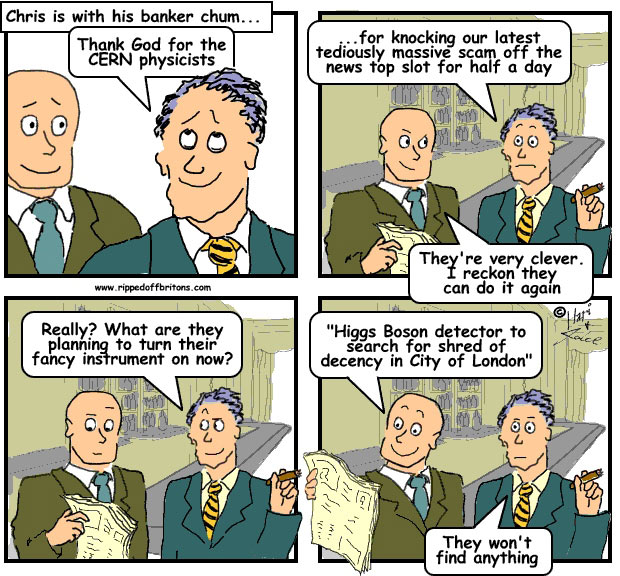
Ripped-off Britons: Cern and the city

Sunday, 14 June 2015

On the 20th May 2015, just weeks after the General Election relieved the Tories of their Liberal Democrat conscience, George Osborne asked the bankers at Rothschild’s to tell him that he should re-privatise RBS (the Royal Bank of Scotland). 

Accordingly Rothschild’s produced a report titled “The UK investment in the Royal Bank of Scotland”. The report says the government should indeed re-privatise RBS. To cover their expensively pinstriped backsides Rothschild's started the report with a disclaimer which included statements such as:
"The Report has been prepared on the basis of publicly available information. This information has not been independently verified by Rothschild....no responsibility or liability is or will be accepted by Rothschild or by any of their officers, servants, agents or affiliates as to or in relation to the accuracy or completeness of the information forming the basis of this Report"

In short, Rothschild's stated: we took the information we were given; we didn't check whether it was correct; we didn't check whether it was complete; don't blame us if it is wrong.

The report managed to assert that we, the British taxpayers, not only get our money back but we make a £14.3 billion profit! The report concedes that we made a loss from RBS alone, estimated at £7.2 billion. But taking into account all the financial sector crash rescues together: RBS, Lloyds, UKAR (i.e. the remains of Northern Rock and Bradford & Bingley) and various other unspecified institutions the report claims an overall surplus of £14.3 billion. 


To see if this is true, we took a look at publicly available information from the National Audit Office (NAO).
 
1) "Cash and fees received"
Consider in the Rothschild's table above, Shaded in purple, the "Cash and fees received" and the "CGS fees" and "SLS fees":
The Rothschild's report states “We also take into account the fees received by the government under the Credit Guarantee Scheme and Special Liquidity Scheme (industry-wide funding and guarantee schemes) under which there is no remaining liability to the taxpayer and no payments were made.”

What's this about? The banks bought £1.029 trillion (equal to 80% of all publicly owned wealth put together: £1.34 trillion in 2013-14) of insurance cover from the government to protect them against further losses. This insurance came mainly in the form of the Credit Guarantee Scheme, the Special Liquidity Scheme, and the Asset Protection Scheme

The banks didn't claim on this insurance, so Rothschild's decided they would use the premium to put against the amount the banks owed the government. You try going to your insurer and see what they say if you ask for your premiums back because you didn't make a claim. And you want the money to pay off your overdraft.


Also included in this "cash received" is interest paid by the banks on £133 billion in loans the government gave them. (This £133 billion is not included in the "Amount Injected" figures in the table above).

[Text in purple and red below is taken from the National Audit Office].


There were two types of support provided:

  • Provision of guarantees and other non-cash support. The main items under this heading are the Credit Guarantee Scheme, Special Liquidity Scheme and Asset Protection Scheme, as well as various other guarantees and indemnities provided to UK banks.

  • Provision of cash in the form of loans to the Financial Services Compensation Scheme and insolvent banks to support deposits, and the purchase of share capital in Royal Bank of Scotland and Lloyds Banking Group.

Peak Support
  • Guarantee commitments [insurance]: £1.029 trillion
  • Cash outlay [loans]: £133 billion
  • Total Peak Support: £1.162 trillion

The National Audit Office states that this £17 billion in cash and fees received by the government is actually less than the cost to the government of providing the support. For Rothschild's to include this to show the taxpayer made an overall profit is nonsense. The sort of blinkered accounting that got the banks into the Credit Crisis in the first place. The NAO explicitly states the taxpayer made a loss:

  • The fees and income received. As at 31 March 2014, the Treasury had received a total of around £17 billion in fees and interest for providing the support and assuming the risks covered by the guarantees since 2008. This is below the cumulative finance cost.

2) "Outstanding Payments"
Shaded in green in the Rothschild's table above, "Outstanding Payment" refers to £20.3 billion still owed by the banks to the government. For example RBS owed £1.2 billion to buy back the government's right to the lion's share of dividends, their "Dividend Access Share". Something RBS is keen to do so it can restart paying dividends, which haven't been paid since its rescue by the government.


Rothschild's assumes this £20.3 billion will all be payed back. Taken literally one can't argue with this. If the banks decide they don't have the money, then the taxpayers will bail them out. The taxpayer picking up these banks' debts to the taxpayer would actually be relatively small beer in the grand scale of things the taxpayer has been picking up for the financial sector.

3) Loss due to government's cost of borrowing
Something Rothschild's have completely omitted is the government had to borrow the money used to bail out the banks. 

Odd that bankers never forget about the interest when we borrow from them, but it completely slips their minds when they borrow from us.

The National Audit Office states the government paid a bit under 3% interest on the money it borrowed to bail out the financial services industry:

"Costs arising from the additional government borrowing raised to finance the purchase of the shares and loans.. The money needed to make the interventions was provided by longer-term funding in the form of Gilts (interest-bearing government bonds purchased by investors for periods of up to 50 years), at a cost of just under 3% a year."

During past sales of Lloyds Bank shares George Osborne claimed to be making a profit by comparing the sale price with the original bailout purchase price. He pulls this off by ignoring the 3% interest cost to the government. The reality is all these Lloyds share sales were made at a considerable loss:


Taking this 3% interest into account, we can see the real loss the British taxpayer has made in what Rothschild's describes as its "investment in the Royal Bank of Scotland":

4) The Opportunity Cost:
The Opportunity Cost represents what may have been gained if the government used the money given to bailout the banks on something else. 

The National Audit Office stated,
"The income generated by fees and interest is less than would be expected from a normal market investment and has not compensated the taxpayer for the degree of risk accepted by taxpayers in providing the support. Once the opportunity cost and risks are factored in, the schemes have represented a transfer from taxpayers to the financial sector."

For example, what if the government had built houses in Greater London to relieve the "housing crisis"? Using the Halifax House Price Index for Greater London, we can see how much more was lost for not doing the things we could have done:

It is ironic that the chancellor asked the bankers at N.M.Rothschild's to advise him. About 200 years ago an earlier head of the bank, a chap called N.M.Rothschild, said "Buy when there is blood in the streets". His meaning was to buy cheap when everyone else is panicking, so you can sell at a healthy profit later when everyone has calmed down. Instead, Osborne has decided to sell RBS at a loss. 

It is clear from the National Audit Office that the UK Taxpayer has made a large loss on the bailouts overall. 

But let's consider RBS alone. To estimate how big a loss the taxpayer investment in RBS actually is, as at 5th June 2015 (the date for which figures in the Rothschild's report are done):

[Figures in Rothschild's report are in blue; figures that didn't make it into the report are in purple; figures included in the report that shouldn't be, the bogus "cash and fees", are in green]
  • Amount injected between Dec2008 and Dec2009: £45.8 billion
  • Government paid interest on this £45.8 billion at 3% for 6 years: £8.2 billion in interest
  • "Cash and fees" from Rothschild's report £4.5 billion not included in the 'surplus'
  • Value of RBS shares stated in Rothschild's report: £32.4 billion 
  • Loss stated in Rothschild's report: £7.2 billion
  • Actual loss = £7.2b + £4.5b + £8.2b = £19.9 billion

It was perhaps inevitable that the big winners from the banking crash would be the banking sector. RBS, we are told, will thrive under private ownership because it will be able to do things it can't do under public ownership. 

We shudder to think what those things are, having already experienced Payment Protection Insurance, Interest Rate Swap Agreements, and various other scams pulled off by privately held banks in recent years.

And so here we are again. The taxpayers, having rescued and sheltered the collapsed banks, now release them back into the wild private sector, where we can continue to be their victims in the various shenanigans that are known collectively as "banking". 


Sadly there is nothing much we can do about that. But one thing we can do: when they tell you we British taxpayers made a profit from the banking bailouts take advice not from Rothschild's report but from Tom the cartoon cat: "Don't you believe it!"


Tuesday, 28 April 2015

Tuesday, April 28, 2015 Posted by Hari 2 comments Labels: , , , , ,

SOURCE DAILY MAIL: Britain's biggest banks face further £19bn of fines and charges to pay for financial scandals
The UK’s ‘big four’ banks – HSBC, Barclays, Lloyds Banking Group and Royal Bank of Scotland – have already racked up a £42billion bill in the UK over the last five years. This represents 88 per cent of the industry wide total of £48billion in charges faced by 13 banks and building societies in Britain. S&P said it now expects the UK’s four biggest lenders to face further penalties in 2015 and 2016 of £19billion – taking the total for the big four to £61billion. The bill has been driven by the mis-selling of payment protection insurance (PPI) as well as interest rate hedging products to small and medium-sized businesses. ‘We think that conduct and litigation charges are now a way of life for the UK banking industry,’ said S&P in the report.

Tuesday, 24 March 2015

Tuesday, March 24, 2015 Posted by Hari No comments Labels: , , , , , , , ,

SOURCE: A report by the Centre for Research on Socio-Cultural Change (part of the University of Manchester and the Open University) observed: "the remarkable result is that under Mrs Thatcher from 1979-90, just as under Tony Blair from 1997-2007, the real value of Housing Equity Withdrawal is larger than the real value of GDP growth"

Share This

Follow Us

  • Subscribe via Email

Search Us