TOP STORIES
CARTOONS
MAGIC MONEY TREE
POSH GRAMMAR
OSBORNE KERCHING!!
PROMISES PROMISES
SOUTHERN FAIL
DUMB POLLSTERS
DON'T BLAME TRUMP!
£13bn APPLE TAX DODGE
SAFE SEATS = BREXIT?
UKIP v LABOUR
ALL OUT OF IT TOGETHER
EU IMMIGRATION
TORY v TORY
PRISON SUICIDES
LONDON LEAVES UK!
EU v TORY MANDATE
HMRC IS A TAX HAVEN
PANAMA TAX LEAK
IDS v IDS
RICH v POOR
POSH BOYS
HELP2BUY PROFITEERS
LLOYDS, RBS CEO PAY
HSBC DRUG MONEY
PM'S MUM FIGHTS CUTS
PEAK "STUFF" IS HERE
HMRC GOOGLY
PENSION TAX RAID

Thursday, 26 January 2017

Thursday, January 26, 2017 Posted by Hari No comments Labels: , , , , , , , ,
Where are the jobs and economic growth of tomorrow going to come from? One dead cert is healthcare. So it completely mystifies me that the NHS is always described as a “cost”, whereas increased spending on anything from cars (£71.6bn, up 3%) and games (£4.2bn, up 5%) to soft drinks (£14bn, up 2.7%) and pet products (£4.6bn, up 3%) is celebrated and can win someone a knighthood.

The champions of an economy are the sectors that use high skills, and technological innovation. They are the ones that deliver better products, services, results and overall living standards than they did the year before.

And we’ll always need low and medium skilled jobs. Not just because such jobs support the cutting edge activities, but because getting any product or service out of the door and onto the high street needs skills at every level.
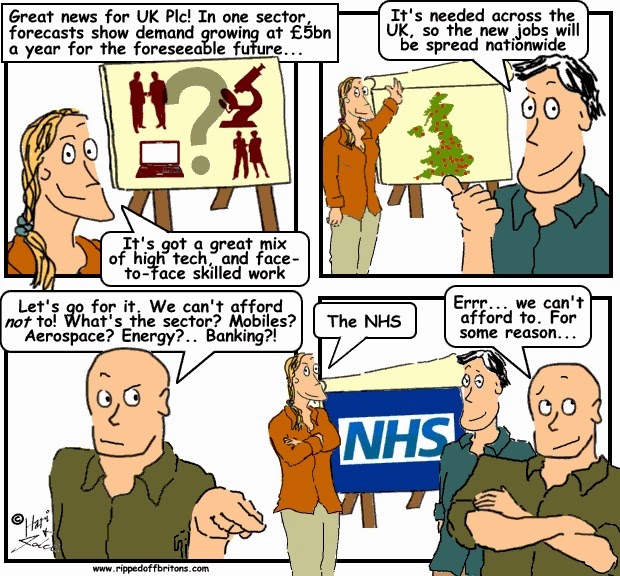
Uniquely, our health industry does it all. From trolley pushers to brain surgeons. From brooms and paperclips to MRI scanners and precision surgical knives.

Healthcare creates jobs from top to bottom within the NHS, and for all the businesses that stock and service the NHS. And on top of all that, uniquely, it does it across the country in every region, rich and poor.

So why are we cutting the NHS? Spending as a percentage of GDP is dropping. Previous governments raised it, recognising it's value in terms of health and wealth.health care spending % GDP
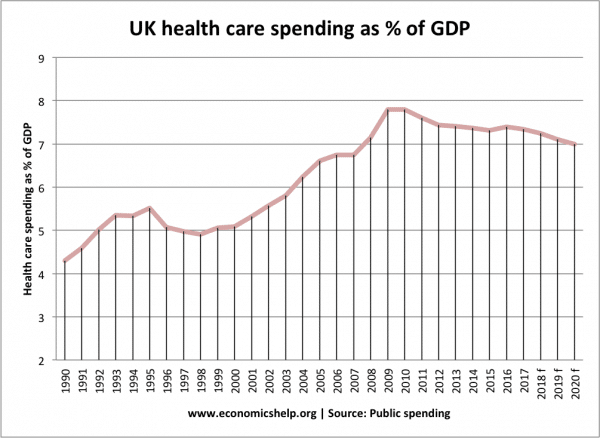
Tory spending per head has flatlined. This is happening while the population is ageing overall, and modern treatments are better yet more expensive.


That’s the core NHS budget. But total health spending in England (which includes things like public health, education and training) is set to fall by almost £5bn over this parliament.

“We can’t afford it!” Why? What were you planning to spend your money on? What makes you think if we spend less on healthcare, we’ll spend it on technology, engineering and other pro-growth sectors in the UK? Give me a tax cut and won’t I spend it on Ubers and coffee, or an imported car that gives one job to a UK car salesman whose skills – polishing a windscreen with his cuff while you sign on the dotted line – haven’t changed since the invention of the car salesman. Our “dazzling” employment figures are holding up overwhelmingly because of the creation of low-skilled, self-employed and zero-hour jobs. As far as UK Plc is concerned, they are dead end jobs.

“We’re cutting NHS fat, not the muscle. They’re efficiency savings.” Show me a report that says the NHS is less efficient than somewhere else. They’re not easy to find. The NHS comes top of most tables. Where it’s beaten (healthy lives: mortality amenable to medical care, infant mortality, and healthy life expectancy at age 60) it’s beaten by countries that simply spend more.

So what’s the difference between spending extra billions via taxes on the NHS, and keeping that money in our pockets so that we can spend it on whatever we like? Big, if you want a modern economy of the top rank (errr... and “universal healthcare free at the point of delivery for all,” you soppy twit). But if you’re offended that someone else (the state) is deciding how your damn money is spent, then you’ll see no difference. Fine, but please take your hands off the nation’s steering wheel, for all our sakes.

Yes, I get it. The right wing ideologues don’t object to spending billions more on the health sector. It’s a sector, and it’s growing, for heaven’s sake! They object to the fact that it’s overwhelmingly publicly owned, and they cannot make profits from it.

Never forget, in the USA where healthcare is the most privatised, health costs leave citizens with less money in their pockets while delivering worse results: $8,233 per capita in the US compared to our $3,268. That's almost £4,000 more spent on healthcare per person, and not on other parts of the economy. It's why the makers and sellers of cars, games, soft drinks and pet products should be the first on the barricades to defend the NHS.

Thursday, 19 January 2017

Thursday, January 19, 2017 Posted by Hari No comments Labels:
World's largest fund manager demands cuts to executive pay and bonuses
BlackRock is demanding cuts to director pension entitlements and an end to huge pay rises as UK companies prepare to put their latest pay deals to shareholders. In a letter to the bosses of more than 300 UK companies, the US fund manager said it would only approve salary rises for top executives if firms increase workers’ wages by a similar amount. It is a significant intervention from a company which is a shareholder in every business listed on the FTSE 100 index. BlackRock has $5.1tn (£4.2tn) of investments and describes itself as the world’s largest fund manager. The company’s head of investment stewardship in Europe, Amra Balic, said in the letter that a failure to meet the standards outlined by the fund manager would call into question the quality of the board. She said pay must be linked to performance. “Executive pay should be strongly linked to performance, by which we mean strong and sustainable returns over the long-term, as opposed to short-term hikes in share prices,” she said. One of the issues highlighted by BlackRock is the gap between the pay rises handed out to the most senior executives, and those awarded to the rest of the workforce. Blackrock said: “Pay should only be increased each year, if at all, at the same level of the wider employee base, and in line with inflation... In case of a significant pay increase year-on-year that is out of line with the rest of the workforce, BlackRock expects the company to provide a strong supporting rationale.” Excessive boardroom pay has moved up the national agenda since the financial crisis of 2008 and prime minister Theresa May stated an ambition to crackdown on poor corporate governance in the UK. GUARDIAN

NHS England chief hits back at Theresa May on health service funding
The boss of the NHS in England directly contradicted Theresa May’s claims about how much the government is putting into the health service in a defiant performance in front of MPs hours after reports that Downing Street had lost faith in him. Simon Stevens, the chief executive of NHS England, told the public accounts committee that the prime minister’s insistence that the service was getting more money than it asked for was not true and asked why under current plans real-terms spending on health would actually fall in 2018-19. May was “stretching it” by claiming that the NHS was getting more than the minimum £8bn by 2020 it asked for, Stevens added, and he complained that health spending is already much lower than in many other European countries. His evidence came as the winter crisis in the NHS deepened further. At least 23 NHS trusts in England have had to declare a black alert this week alone as hospitals implement extraordinary measures to cope with a surge in demand. Freezing weather expected to imminently affect most of Britain could increase the pressures on already over-stretched hospitals, doctors are warning. At the select committee, Stevens held up a page from the Daily Mail to argue the NHS has fewer medics, beds and scanners per head than other countries in Europe, to contradict the suggestion that NHS spending was in line with the average for OECD countries, which he said included countries such as Mexico. The chief executive also took issue with May’s claim that the government would be giving the NHS an extra £10bn by 2020, and described the cuts to capital expenditure within the health service as “robbing Paul to pay Paul”. GUARDIAN

Dieselgate: UK motorists file class-action suit against VW
Thousands of British motorists have launched a lawsuit against Volkswagen over the “dieselgate” emissions scandal, in a claim that could end up costing the carmaker billions of pounds. The group of 10,000 VW owners has filed a class action lawsuit against the German car firm, seeking £30m, or £3,000 each. If the company had to pay £3,000 to each of the 1.2 million people who own affected cars, including its Škoda, Audi and Seat marques, it would cost about £3.6bn. The German firm has yet to reach a settlement with British and European owners affected by the scandal, in which the company admitted using “defeat devices” to cheat emissions tests, making its cars appears greener than they were. It has not compensated British owners despite reaching a £15bn settlement with 500,000 US drivers, offering instead to fix affected vehicles. The class action suit, which is being led by law firm Harcus Sinclair, is expected to claim that drivers should be compensated because they paid extra for what they thought were clean diesel cars. In fact, Harcus Sinclair alleged in a statement on its website that the cars emitted far higher levels of NOx – a mixture of pollutants nitrogen oxide and nitrogen dioxide – than stated. According to the Department for Environment, Food and Rural Affairs, NOx emissions cause 23,000 premature deaths in the UK each year. The law firm’s application for group litigation, which is free for claimants to join, will be heard in the high court on 30 January. GUARDIAN

U.K. Workers Worse Off Than Pre-Crisis as Generational Gap Opens
Median U.K. household disposable income rose 2.2 percent to 26,332 pounds ($32,000) in the 12 months through March, the Office for National Statistics said in a report on Tuesday. But that gain hides disparities between working households, whose 0.2 percent increase lagged the 3.1 percent enjoyed by retired households. That left the median income for workers 1.2 percent below its pre-crisis value. The report comes after the Institute for Fiscal Studies said British workers are facing the longest period of wage stagnation in at least 70 years as faster inflation and lower productivity eat into pay packets. Some commentators say inequality is rising in the U.K., and it’s been cited as driving the rise of a populist and nationalistic backlash in politics and may have even partly fueled the Brexit vote. The latest ONS data contrasts with the assertion that incomes are diverging, with the figures showing the least well-off households have benefited from a bigger rise over the past decade. The median disposable income for the poorest fifth of households rose by 5.1 percent in the 12 months through March, while it fell 1.9 percent for the richest fifth. Still, perceptions of rising inequality have meant the issue is receiving increasing attention, with Bank of England Governor Mark Carney devoting a speech to it last month. He questioned the view that disparity in incomes was growing, saying the picture was complex, “but in general suggests relatively stable but high levels of overall inequality.” In the governor’s view, made in his last major speech of 2016, “it is no wonder that many question their prospects.” Jeremy Corbyn, the leader of the U.K.’s opposition Labour Party, said on Tuesday he backs introducing a limit on high earnings to prevent inequality increasing in Britain after Brexit. The Adam Smith Institute, a London-based research group, criticized the idea, saying it would prevent the U.K. from attracting the best executives to run its biggest companies. “I would like there to be some kind of high-earnings cap,” Corbyn told BBC Radio 4. “We cannot set ourselves up to be a grossly unequal bargain-basement economy on the shores of Europe.” BLOOMBERG

“Anti-tout” Robbie Williams' company puts his tickets directly on resale sites at higher prices
Tickets on Ticketmaster for seats on level one, block 126 - for Robbie Williams's gig at the Etihad Stadium, Manchester, on Friday 2 June 2017 - were found by the BBC's Victoria Derbyshire programme to be priced at £95, before fees. But on Get Me In, for "platinum" seats on level one, block 125, at the same gig, seats were priced at £160 before fees - £65 more expensive. Because the tickets came straight from the artist's management team, all the profit goes directly to them. But Williams's management, ie:music, has previously called on the government to take stronger action against resale sites. In November 2015, his company signed a petition saying: "We as artist, managers and agents deplore the increasing industrial-scale abuse and insider exploitation of tickets for music, arts and sports events by ticket touts, and their online associates and facilitators." Conservative MP Andrew Bingham, part of the Department for Culture, Media and Sport, said that "somehow, [touts] have worked a way round of abusing this [resale] system". He said it appeared that some artists' management teams were "now also complicit in it as well". In December, the Competition and Marketing Authority announced it was to investigate the resale ticketing market, to ensure sales were complying with consumer rights laws. The BBC’s Victoria Derbyshire programme also found resale websites StubHub, Get Me In and Seatwave were providing specialist software - which could be used by touts - to enable users to sell large volumes of tickets through their platforms. BBC NEWS

Court forces Rolls-Royce to pay £671m bribery settlement
The UK's Serious Fraud Office (SFO) found conspiracy to corrupt or failure to prevent bribery by Rolls-Royce in China, India and other markets. The firm apologised "unreservedly" for the cases spanning nearly 25 years. A UK court ruled the aerospace firm would pay £497m plus costs to the SFO, which conducted its biggest ever investigation into the firm. In one example, in Indonesia, senior Rolls-Royce employees agreed to pay $2.2m and give a Rolls-Royce Silver Spirit car to an intermediary. There was an "inference" that this money was a reward for the intermediary "showing favour" to Rolls-Royce in respect of a contract for Trent 700 engines, used in airplanes, the SFO said. The SFO revealed 12 counts of conspiracy to corrupt or failure to prevent bribery in seven countries - Indonesia, Thailand, India, Russia, Nigeria, China and Malaysia. Rolls-Royce said it would also pay $170m (£141m) to the US Justice Department, and a further $26m (£21.5m) to Brazilian regulators. Described by the judge as "a jewel in the UK's industrial crown", Rolls-Royce makes engines for military and civil planes, as well as for trains, ships, nuclear submarines and power stations. The agreement between the SFO and Rolls-Royce, approved by the court on Tuesday, is known as a deferred prosecution agreement (DPA). It is only the third such agreement that the SFO has struck since they were first introduced into UK law in 2014. They allow organisations to pay huge penalties, but avoid prosecution, if they freely confess to economic crimes such as fraud or bribery. That means there are still questions about whether "justice has been served", said Robert Barrington, executive director at Transparency International UK. "Individuals haven't been held to account and the markets - when the share price has gone up today - are perhaps suggesting this isn't really a punishment or deterrent," Mr Barrington said. The firm's shares finished nearly 4.5% higher on the news of the settlements and the company's announcement that its 2016 profits would beat expectations. BBC NEWS

EE mobile firm fined £2.7m for overcharging customers
The watchdog found that the UK's biggest mobile network broke a billing rule on two occasions. Users who called its 150 customer services number while roaming within the EU were incorrectly charged as if they had called the US. That meant customers were charged £1.20 a minute, rather than 19p. As a result, more than 32,145 customers were overcharged a total of £245,000. Despite calls or texts to the 150 number from within the EU becoming free from 18 November 2015, EE continued to bill more than 7,600 customers until 11 January 2016 who were overcharged £2,203. Lindsey Fussell, Ofcom's consumer group director, told the BBC: "We all rely on big companies to get the most basic things right, and that includes charging the right bills... we uncovered a catalogue of errors." Most customers have been refunded, although EE could not identify at least 6,900 who were more than £60,000 out of pocket. EE has donated about £62,000 to charity in lieu of this sum, but Ofcom has ordered the company to make further attempts to trace and refund every customer who was overcharged. Current and former customers who believe they have been overcharged can contact EE on 0800 956 6000. In October, Ofcom fined Vodafone a record £4.6m for "serious" breaches of consumer protection rules. The regulator found the mobile operator had misled more than 10,000 pay-as-you-go customers, charging them for top-up credit but "providing nothing in return", and had broken the rules on handling customer complaints. BBC NEWS

US accuses Fiat Chrysler of excess diesel emissions
The U.S. Environmental Protection Agency on Thursday accused Fiat Chrysler Automobiles NV of illegally using hidden software to allow excess diesel emissions to go undetected, the result of a probe that stemmed from regulators' investigation of rival Volkswagen AG. FCA shares plummeted as the maximum fine is about $4.6 billion. The EPA action affects 104,000 U.S. trucks and SUVs sold since 2014, about one-sixth the vehicles in the Volkswagen case. The EPA and California Air Resources Board told Fiat Chrysler it believes its undeclared auxiliary emissions control software allowed vehicles to generate excess pollution in violation of the law and each issued notices of violation. Fiat Chrysler Chief Executive Sergio Marchionne angrily rejected the allegations at a hastily-assembled conference call with reporters, saying there was no wrongdoing and the company never attempted to create software to cheat emissions rules by detecting when the vehicle was in test mode. He characterized the dispute as whether the automaker had completely disclosed software that protects the engine, adding the company was planning updated software to address EPA concerns. He said the EPA and the company could have settled the issue in "a more efficient way" without the EPA announcement, and he said "I'm really pissed off" about reports that equate FCA's issues with VW's. He also suggested regulators had a "belligerent" view of automakers. "We don't belong to a class of criminals," he said. "We're not trying to break the bloody law." The company has no plans to stop selling 2016 U.S. diesel models. EPA has reviews ongoing of other automakers' emissions systems, but it is not clear if they have found any additional wrongdoing. Regulators said FCA failed to disclose engine management software in 104,000 U.S. 2014-2016 Jeep Grand Cherokees and Dodge Ram 1500 trucks with 3.0-liter diesel engines. The undisclosed software results in increased emissions of nitrogen oxides (NOx). Cynthia Giles, an EPA official, said Fiat Chrysler had an obligation to disclose the "illegal software" but has not decided whether to label them "defeat devices." The EPA said it found at least eight undisclosed pieces of software that can alter how a vehicle emits air pollution. Fiat Chrysler had recalled vehicles for one of the undisclosed software. By contesting the charge, FCA will push the case into the administration of President-elect Donald Trump. It is not clear how Trump’s EPA will handle this or similar issues. Trump has nominated Oklahoma Attorney General Scott Pruitt, a critic of federal environmental regulation, to lead EPA. Efraim Levy, analyst with CFRA, said FCA stands to "get a fresh start with the Trump administration." REUTERS

Tuesday, 10 January 2017

Tuesday, January 10, 2017 Posted by Hari No comments Labels: , , , , , , , , ,
KJ and Fee celebrate Theresa May's Tory u-turn, for the moment...
For we know what happens when mainstream, centre-ground politics fails. People embrace the fringe – the politics of division and despair. They turn to those who offer easy answers – who claim to understand people’s problems and always know what – and who – to blame. We see those fringe voices gaining prominence in some countries across Europe today – voices from the hard-left and the far-right stepping forward and sensing that this is their time. But they stand on the shoulders of mainstream politicians who have allowed unfairness and division to grow by ignoring the legitimate concerns of ordinary people for too long. Politicians who embraced the twin pillars of liberalism and globalisation as the great forces for good that they are, but failed to understand that for too many people – particularly those on modest to low incomes living in rich countries like our own – those forces are something to be concerned, not thrilled, about. Politicians who supported and promoted an economic system that works well for a privileged few, but failed to ensure that the prosperity generated by free markets and free trade is shared by everyone, in every corner and community of their land.

The plans aim to make mental health an everyday concern for every bit of the system, helping ensure that no one affected by mental ill-health goes unattended. It includes... new ways to right the injustices people with mental health problems face. Despite known links between debt and mental health, currently hundreds of mental health patients are charged up to £300 by their GP for a form to prove they have mental health issues.


OUR RELATED STORIES:

FTSE bosses take 2.5 days to earn what you earn all year. Data shows they don't deserve it

All governments agree to fix the housing crisis. Latest figures show we're still not even trying

Recovery? What recovery?! Bank of England director explains why broke Britain is still broken

Brexit was about inequality in Britain, not immigration. Have our politicians realised this?

See the Stats: Osborne's 2016 budget protected the wealthiest while the most vulnerable suffer

Inequality: the UK has 9 of the 10 poorest regions in Northern Europe. But Inner London is the richest

Graphs at a glance: With highest pay and highest job growth is London sucking the life out of Britain?

Londoners earn 15% more 'cos London is damn expensive! But the poorest 5th in London are paid only 4% more

Graphs at a glance: Britain is already a low-pay economy with falling average wages

Is your Cost of Living crisis over?! Average wages are still back where they were 10 years ago


Saturday, 7 January 2017

Saturday, January 07, 2017 Posted by Hari No comments Labels: , , , , ,
"Fat Cat Wednesday 2017" 

Welcome back to work. FTSE100 bosses will have already clocked up an average annual UK salary just two-and-a-half days into the working year

  • Top bosses will already have made more money by the first Wednesday of 2017 than the typical UK worker will earn all year
  • The average pay ratio between FTSE100 CEOs and the average total pay of their employees in 2015 was 129:1
  • Making the publication of pay ratios compulsory will help track progress on closing this gap


It’s Fat Cat Wednesday (4.1.2017). After just two and a half days Britain’s top bosses will have made more money than the average UK worker earns in an entire year, according to High Pay Centre calculations.
The figures show that pay for top company executives returning to work this new year will pass the UK average salary of £28,200 (note 2 below) by around mid-day on “Fat Cat Wednesday”.

After a year in which “elites” were criticised for being out of touch and ignorant about the concerns of ordinary people, these pay gap figures confirm that there are dramatically different rates of pay at the top compared with what everyone else receives.
Median FTSE100 CEO pay in 2015 was £3.973 million (note 1 below). We found that even if CEOs are assumed to work long hours with very few holidays, this is equivalent to a rate of pay of over £1,000 an hour (note 3 below). The “national living wage” for over 25s is £7.20 an hour.

High Pay Centre director Stefan Stern said: “Our new year calculation is not designed to make the return to work harder than it already is. But ‘Fat Cat Wednesday’ is an important reminder of the continuing problem of the unfair pay gap in the UK. We hope the government will recognise that further reform to pay practices are needed if this gap is to be closed. That will be the main point in our submission to the business department in its current consultation over corporate governance reform.

“Reality check” needed

“Effective representation for ordinary workers on the company remuneration committees that set executive pay, and publication of the pay ratio between the highest and average earner within a company, would bring a greater sense of proportion to the setting of top pay,” Stern added.
The huge increase in top pay in recent years seems to have arisen because of so-called “performance-related pay” awards. But as new research from Lancaster University Management School has revealed, the link between pay and performance has in fact been “negligible”:

GUARDIAN: 'Negligible' link between executive pay and firm's performance
INDEPENDENT: Link between high executive pay and performance ‘negligible’
FINANCIAL TIMES: ‘Negligible’ link found between executive pay and performance

This is not just a FTSE100 company problem. AIM-listed Asos is being criticised today by the GMB union for a similar vast gap in pay created by the chief executive’s “Long Term Incentive Plan” (for more information contact jon.parker-dean@gmb.org.uk).

And excessive private sector pay deals set a bad example to some public sector and not-for-profit organisations, as controversy over the pay for some university vice chancellors, school “superheads”, NHS Trust chief executives, local authority leaders and some charity bosses suggests.

The continuing pay gap creates problems for us all.

Notes:
1. The median pay for a FTSE 100 CEO in 2015 was £3.973 million, based on the publicly disclosed “single figure” measure http://highpaycentre.org/pubs/10-pay-rise-thatll-do-nicely (There are different ways of measuring executive pay, and the single figure measure differs from the “pay realised” figure and the pay awarded figures available from Manifest.)
2. Median earnings for full-time workers in the UK (who had been in their job for at least 12 months) were £28,200 in 2016https://www.ons.gov.uk/employmentandlabourmarket/peopleinwork/earningsandworkinghours/bulletins/annualsurveyofhoursandearnings/2016provisionalresults. This represents an increase from £27,645 in 2015.
3. Even when making the generous assumption that FTSE 100 CEOs work 12 hours a day, including three out of every four weekends, and take fewer than 10 days holiday per year, this still works out at about £1,009 per hour, meaning that it would take around 28 hours’ work to surpass the UK average of £28,200 – some time around mid-day on Wednesday 4th, assuming they begin work for the year on Monday January 2nd.
4. The High Pay Centre is an independent think-tank set up to examine corporate governance and pay at the top of the income distribution. We carry out research aimed at developing a better understanding of top rewards, company accountability and business performance.
5.

The 10 highest paid CEOs in 2015 and 2014 were as follows:

Thursday, 5 January 2017

Thursday, January 05, 2017 Posted by Hari No comments Labels:
Row over 'affordable' starter homes that will cost up to £450,000
Housing minister Gavin Barwell pledged that 2017 would see the first wave of the discounted homes built on brownfield sites in 30 local authority areas around England. But Labour and the housing charity Shelter said it was a nonsense to describe them as “affordable” when they would cost up to £450,000 each. Furthermore, Mr Barwell was unable to say how many homes would be built this year – making the original target of 200,000 by 2020 impossible, Labour said. Ministers had suggested that – under Theresa May’s leadership – the Government would refocus the starter homes project to include some properties to rent, as well as to buy. But the houses to be built this year will be made available exclusively to first-time buyers aged between 23 and 40, at a discount of at least 20 per cent below market value. That means a cap of £250,000 outside London – but a ceiling of an eye-watering £450,000 in the capital. Yet, most controversially, the starter homes will count towards the Government’s target to build 400,000 new “affordable homes”. Roger Harding, Shelter’s director of communications, said: “Efforts to build more homes are welcome, but these starter homes are only likely to benefit people who are better off and already close to buying." The first areas will begin construction later this year. INDEPENDENT

Young people with the best paid jobs also likely to inherit the most wealth
Britain’s wealth gap will be passed down the generations as well-off older people bequeath property to their already thriving offspring, according to new research from one of the UK’s leading thinktanks. The Institute for Fiscal Studies (IFS) found that today’s young people were likely to inherit more wealth than their predecessors but the benefits would be skewed to those who were already well off. The study concluded that inequality was likely to increase and social mobility hindered as pensioners bequeathed the wealth they had accumulated as a result of rising home ownership and property-price inflation. “Between 2002-03 and 2012-13, the wealth of elderly households (those in which all members are 80 or older) increased by 45%, mostly as a result of higher homeownership and rising house prices,” the IFS study said. It added that 72% of those households now expected to leave an inheritance, up from 60% a decade earlier, with a sharp increase in the proportion expecting to leave a large inheritance. Property wealth has increased and become more widely spread in recent generations. Owner-occupation rose from 30% at the end of the second world war to a peak of 70% at the turn of the millennium, while property booms in the 1970s, 1980s and 2000s have seen house prices rise by almost 300% in real terms in the half-century ending in 2010. As a result of these trends, the IFS said younger generations looked much more likely to inherit than their predecessors. Someone born in the 1930s had a 40% chance of an inheritance, rising to 61% of those born in the 1950s and 75% of those born in the 1970s. But the thinktank warned that future inheritances were set to be highly unequal given that the richest half of elderly households held 90% of the wealth and the richest 10% held 40% of the wealth. “Hence a ‘lucky half’ of younger generations look likely to get the vast majority of inherited wealth.” The largest inheritances would in the main go to those who were already well off. More than half of those likely to secure an inheritance of at least £250,000 had incomes in the top 20% of the population. Andrew Hood, from the IFS, said: “The wealth of younger generations looks set to depend more on who their parents are than was the case for older generations. Today’s elderly have much more wealth to leave to their children than their predecessors did. At the same time, today’s young adults will find it harder to accumulate wealth of their own than previous generations did, due to the sharp fall in homeownership for that group, the dramatic decline of defined benefit pensions in the private sector and the stagnation in their incomes.” GUARDIAN

Household debt rises to post-credit crunch high
Bank of England data shows personal debt grew 10.8% in the year to 30 November to £192.2bn in the UK - the highest level since December 2008. Personal debt includes credit cards and bank loans but not mortgages or student loans. Debt charity Step Change is calling on the government to adopt a scheme that gives problem debtors 12 months' breathing space to get back on track. The government says it is reviewing whether to bring in such a scheme. But that decision is now 12 months overdue, and the charity estimates that a further one million people fell into problem debt during this period. Debt counsellors say many debtors are now using credit cards to pay for essential living costs, rather than luxury items. Things are likely to get tougher for many people, with inflation expected to rise in 2017. StepChange says it has experienced the busiest period in its history, with more than 300,000 people calling it for money advice in the first six months of 2016. BBC NEWS

It's Fat Cat Wednesday! FTSE bosses have already earned the average UK wage just two-and-a-half days into the working year
The High Pay Centre has branded today Fat Cat Wednesday because of the shocking figures. It takes the average chief executive of a leading business just two-and-a-half days to earn the average salary of £28,200, said the independent body. It would take just over an hour-and-a-half for the best paid, Sir Martin Sorrell, said the centre. As boss of advertising giant WPP, a long-term bonus took his total package to £70million last year. The findings will pile pressure on Theresa May to tackle excessive pay after she criticised the ‘irrational and unhealthy’ divide between bosses and ordinary workers. Even the Institute of Directors has called for ‘corporate awareness’. It has warned that some executives have ‘assumed massive rewards while taking little of the personal risk’ usually associated with entrepreneurs. The average pay for a FTSE 100 chief executive is nearly £4million or just over £1,000 an hour, said the High Pay Centre. The centre warns that excessive pay deals in the private sector ‘set a bad example’ to the public sector and not-for-profit organisations. This is seen by the huge amounts given to some headteachers and leaders of NHS trusts, councils and charities. Simon Walker, director general at the Institute of Directors, pointed to the threat of an official clampdown. ‘Unless boards show they are listening and responding, the Government’s trigger finger will just get itchier and itchier,’ he said. ‘The problem is that over the past few decades managers have assumed massive rewards while taking little of the personal risk.’ Frances O’Grady, general secretary of the TUC, said: ‘Working people deserve a fair share of the wealth they help create. The Prime Minister must stick to her promise to tackle excessive pay at the top.’ A report from The Equality Trust today added to concerns about the pay gap. It said the average FTSE 100 chief executive earned 172 times more than a nurse, 145 times more than teacher, 137 times more than a police officer and 324 times more than a care worker in the 2015-16 financial year. DAILY MAIL

Zero-hours workers 'face £1,000 pay penalty'
Workers on zero-hours contracts typically earn £1,000 a year less than permanent employees, according to Resolution Foundation research. People on the controversial contracts face a "precarious pay penalty" of 6.6%, or 93p an hour, the think tank has estimated. For those who earn the least, the size of the gap is even greater, at 9.5%. The foundation backed the government's decision, announced last month, to hold a review into modern working practices. Laura Gardiner, senior policy analyst at the Resolution Foundation, said: "Zero-hours contracts have hit the headlines in recent months for their widespread use in Sports Direct and JD Sports. But concern about the use and abuse of zero-hours contracts goes far wider than a few notorious firms. There is mounting evidence that their use is associated with a holding down of wages. As new ways of working continue to grow - from [zero-hours contracts] and agency work to the gig economy and wider self-employment - we need a better understanding of how they help or hinder people's earnings and career prospects.” BBC NEWS

Rail fares: train operators accused of milking the system as rises kick in
Higher rail fares have come into effect, with passengers across Britain facing an average rise of 2.3%, prompting renewed outcry from campaigners. The overall rise in prices will outstrip the increase in season tickets set by the government, leading unions to accuse private train companies of milking the system. Labour party research shows that season tickets have gone up by an average of 27% since 2010, while the TUC found that rail fares had risen at more than twice the rate of inflation and wages over the last decade. According to Labour, some commuters will now payover £2,000 more to travel to work than when the Conservatives came to power in 2010. A comparison of costs on nearly 200 routes shows that the average commuter is now paying £2,788 for their season ticket, £594 more than in 2010. A Virgin Trains season ticket between Birmingham and London now costs £10,200, up £2,172 since 2010, while commuters travelling from Brighton to London on the troubled Southern Rail route now pay almost £1,000 more than in 2010, Labour’s research found. The transport secretary, Chris Grayling, defended the situation. He said: “We are delivering the biggest rail modernisation programme for more than a century, providing more seats and services. We have always fairly balanced the cost of this investment between the taxpayer and the passenger.” The TUC general secretary, Frances O’Grady, said: “British commuters are forced to shell out far more on rail fares than others in Europe. Many will look with envy at the cheaper, publicly-owned services on the continent.” GUARDIAN

HMRC empowered to name and shame tax evasion 'enablers'
Tax advisers, accountants and lawyers who aid the super-rich with offshore tax evasion will face tough new penalties from New Year’s Day, with HMRC now able to publicly name and shame “enablers”. The Treasury said the government’s new powers would see individuals or corporations who take deliberate action to help others evade paying tax facing fines of up to 100% of the tax they helped evade or £3,000, whichever is highest. The new crackdown, first announced by the then chancellor George Osborne in the 2015 budget, will mean HMRC can, for the first time, penalise the facilitators of tax evasion who help to physically move funds abroad or advise on offshore tax saving. A new corporate criminal offence of failing to prevent the facilitation of tax evasion will also be introduced this year, with companies held liable if an individual acting on their behalf as an employee or contractor facilitates tax evasion. Previous rules meant a corporate criminal prosecution was only possible if there was proof that the board of directors were aware and involved in facilitating the evasion. The Treasury said HMRC had secured more than £2.5bn specifically from offshore tax evaders since 2010. However, the department was criticised last November after its new specialist tax evasion unit only successfully pursued one criminal prosecution, despite having identified potential evasion and avoidance worth nearly £2bn after examining the tax affairs of 6,500 super-rich individuals. The Treasury said more action was planned in the coming months, including a consultation on a new requirement for businesses and individuals who create complex offshore financial arrangements that bear the hallmarks of enabling tax evasion to notify them to HMRC. May pledged during her leadership campaign that she would pursue companies and individuals who took part in deliberate tax avoidance. “It doesn’t matter to me whether you’re Amazon, Google or Starbucks: you have a duty to put something back, you have a debt to fellow citizens and you have a responsibility to pay your taxes,” she said. GUARDIAN

Aldi to become highest-paying supermarket in UK
Aldi is to give more than 3,000 staff a pay rise in an effort to leapfrog fellow German discounter Lidl to become the highest-paying supermarket in the UK. Employees at the fast-growing supermarket chain will earn £8.53 per hour and £9.75 if they live in London, starting from 1 February. While Aldi’s hourly rate in the capital will be the same as the new minimum announced in November by Lidl, staff outside London will earn 7p an hour more. Both supermarket chains have now matched or bettered the the voluntary minimum pay suggested by the Living Wage Foundation. Aldi said the increase means it is now the highest paying company in the supermarket sector, adding that 3,356 staff stood to benefit. It pointed out that it also paid staff for breaks, which it claimed Lidl did not. Aldi’s UK chief executive, Matthew Barnes, said: “We employ the best people in retail and invest in their training to enable them to carry out a range of different roles in store... We remain committed to being the best supermarket employer in Britain. This means that we will continue to provide employees with rates of pay and benefits that are the highest in the supermarket sector.” GUARDIAN

Thursday, 15 December 2016

Thursday, December 15, 2016 Posted by Hari No comments Labels:
Taxpayers foot £50m bill for Southern rail strike
Because of a deal struck with Southern by the Government, the cost of the disruption will be borne by the taxpayer. Under the seven-year deal, the Government pays Govia more than £1 billion a year to run the service. Ministers agreed to bear the financial risk of running the railway because of the significant disruption caused by the redevelopment of London Bridge station. In return, the fees that Southern collects in fares are passed to the Government. It means that during the 20 days lost to strikes this year – when there are no fares to collect – the Government must bear the cost of £38 million in lost revenue. The deal also states that the Government will pick up the tab for compensation claims likely to be filed by passengers who have paid season ticket fares but have no services to catch – an estimated £15 million. Nick Herbert, the Conservative MP for Arundel and South Downs and a former minister, said:  “Because of the way the franchise is structured, there isn’t proper accountability. It should be the company bearing the cost of compensation and failure to meet targets.” Meanwhile, Govia Thameslink Railway, the company that runs Southern, is saving an estimated £1.1 million in pay for train drivers and conductors who are out on strike this week. Govia could still be hit with financial penalties totalling tens of millions of pounds for delayed and cancelled services. However, it is claiming that disruption caused by strikes and staff sickness is a force majeure and it should therefore not have to pay the fines. TELEGRAPH

How Britain's biggest shops are pocketing YOUR delivery fee refunds on unwanted items and making up to £4.1bn
Online stores including Asos, Boohoo and Topshop routinely pocket the postage and packaging costs - often called delivery fees or charges - when customers return goods. A Money Mail investigation reveals that these online retailers could be breaking a little-known consumer law. According to the Consumer Contracts Regulations, introduced in 2014, customers who return items should get a refund for the price of the goods and the standard postage costs they paid for home delivery. Lawyers say the original delivery fee should be handed back automatically as part of any refund if the items are returned within a set period. Yet our research found many shops hold on to the cash - typically around £3 per delivery - unless you ask for it. Often your rights are buried in the smallprint on retailers’ websites. Then customers are made to jump through hoops to get the money they’re owed, such as filling in extra forms or making phone calls. For example, the press office for online clothes shop Asos, which made £1.4 billion in sales in the past financial year, says it does refund its £3 postage charge if a shopper asks. But when Money Mail contacted its customer services, an email came back saying the fees were a ‘non-refundable cost’ and made no mention of the law. Experts say most shoppers fail to claim because they are unaware of their rights or do not have time. In the UK, some 1.38 billion items were returned last year, says consultancy Clear Returns. It means shops could be sitting on £4.1 billion of postage fees. The Consumer Contracts Regulations 2014 state that if you return items bought over the phone or internet within 14 days of receiving them, you should receive a full refund. There does not have to be anything wrong with the goods: it’s enough simply to have changed your mind. The rules state that as well as a refund for the item, customers should get back their original, standard delivery costs if they return the whole order at once. DAILY MAIL

Families 'left at the mercy of fraudsters' who cost us £15bn a year after number of trading standards officers is cut by 56% since 2009
The National Audit Office (NAO) says consumer protection is suffering following massive cuts to trading standards services. Trading standards officers point to the horsemeat scandal, problems with exploding hoverboards and the fires linked to tumble dryers as evidence of what is going wrong. 'Some services now have only one qualified officer,' said the NAO. 'Despite this lack of funding, local trading standards teams are expected to enforce 263 different pieces of legislation for different government departments with little direction from government on the priority of these.' The NAO pointed to problems such as mass marketing scams, often involving bogus prize drawn, which are widespread and impact on the elderly and vulnerable. It said a typical postal scam victim, who is 74 years old and lives alone, will lose around £4,500. 'Many experience psychological problems,' said the NAO. The watchdog said e-crime is becoming a huge problem with, among other things, criminals defrauding wealthy individuals of large sums of money by selling non-existent investments. There is a problem of unsafe goods, which can cause injury and fatalities. Common recent examples include make-up that contained carcinogens, counterfeit medicines, and electrical items which caught fire when charging. And there is a burgeoning black market in counterfeit items. The NAO pointed to problems such as mass marketing scams, often involving bogus prize drawn, which are widespread and impact on the elderly and vulnerable. It said a typical postal scam victim, who is 74 years old and lives alone, will lose around £4,500. 'Many experience psychological problems,' said the NAO. The watchdog said e-crime is becoming a huge problem with, among other things, criminals defrauding wealthy individuals of large sums of money by selling non-existent investments. National audit office chief  Amyas Morse said Consumer protection bodies have shown they can make good impacts with limited resources. National audit office chief  Amyas Morse said Consumer protection bodies have shown they can make good impacts with limited resources. There is a problem of unsafe goods, which can cause injury and fatalities. Common recent examples include make-up that contained carcinogens, counterfeit medicines, and electrical items which caught fire when charging. And there is a burgeoning black market in counterfeit items. DAILY MAIL

Unpaid benefits at record level
A total of £1.7bn in benefits was not paid to those entitled to the money in 2015-16, a new record rate of underpayment. Nearly 65% of underpaid benefits - the equivalent to about £1bn a year - was the result of inaccurate information from claimants. The government said it was providing more help to claimants to provide accurate information. But David Samson, the welfare benefits project manager at the Turn2us charity, said that this support was not always easy to get. "People are finding it harder and harder to access face-to-face help with completing these forms, which is why this problem goes unnoticed. This is a particular concern for people living with a mental health problem or who have learning difficulty who may need the extra support when completing them. The latest figures showed the biggest rise in benefit underpayments was in Pension Credit, a top-up to the state pension for low-income pensioners. With this benefit, the DWP admitted that the biggest cause was official error. A year ago, the work and pensions select committee said that, while many parts of the welfare system worked well, underpayments needed a higher priority. Benefit problems "often led claimants to face difficult decisions over whether to pay their rent or provide essentials such as food, gas and electricity for their household", it concluded, with many becoming reliant on food banks as a result of underpaid benefits. Overpayments of benefits totalled £3.3bn, the equivalent of 1.9% of benefit payments, the DWP figures show. BBC NEWS

Completely fee-free basic accounts for the poor: millions are still paying fees
Basic bank accounts are designed for people who do not already have a bank account and are ineligible for a standard current account. While eight million people have basic accounts, around half of them are still liable to pay fees for failed payments. Completely fee-free basic accounts have been available since January 2016, following an industry agreement. Vulnerable customers who have such accounts are not charged for failed payments, or for going overdrawn. The Treasury figures show that 3.7 million people have accounts that do not conform to the agreement, struck between the government and the banking industry, in 2014. Of those, 3.6 million bank with Lloyds. Only 4% of those who have basic bank accounts with Lloyds have access to the cheapest banking terms, the figures show. Royal Bank of Scotland (RBS) is the only other bank where some basic account customers have to pay fees. At the other seven big High Street banks, all basic account holders receive the best deal on offer. BBC NEWS

Abandon net migration target, says CBI
The employers group, the CBI, is calling on the government to abandon an immigration target which was set by David Cameron and which then proved part of his undoing. Britain's biggest business group is attempting a very difficult balancing act. The CBI needs to acknowledge public concern over immigration while at the same time warning about looming labour shortages in key industries like agriculture, care and construction. The CBI insists that immigration has had little impact on wages, particularly in low-skilled areas. But privately, many bosses acknowledge that immigrants, who often sleep several to a room, and often leave their families back in Eastern Europe, are prepared to work for lower wages. And that depresses wages at the bottom of the pay scale. A Bank of England study found that although small, there was a "statistically significant" negative impact on wages in some unskilled occupations which had high concentrations of immigrant workers. The CBI raises some very real challenges facing UK businesses and the economy as a whole. There are serious questions about who will build Hinkley C nuclear power station, an expanded Heathrow airport, the HS2 railway project, and hundreds of thousands of new homes. An ageing population will need more carers, and turnips don't pick themselves. The government has been making some conciliatory noises. Speaking to business leaders in Cardiff, Brexit Secretary David Davis said that while freedom of movement will end in its current form, the government does not want to end up with damaging labour shortages in key areas. That raises the potential for work permits or visas to be issued on a sector-by-sector basis, as required by particular industries. BBC NEWS
Thursday, December 15, 2016 Posted by Hari No comments Labels: , , , ,
Chris and KJ realise it's Govia Southern Rail that has us over a barrel...

SOURCE TELEGRAPH: Taxpayers foot £50m bill for Southern rail strike
Because of a deal struck with Southern by the Government, the cost of the disruption will be borne by the taxpayer. Under the seven-year deal, the Government pays Govia more than £1 billion a year to run the service. Ministers agreed to bear the financial risk of running the railway because of the significant disruption caused by the redevelopment of London Bridge station. In return, the fees that Southern collects in fares are passed to the Government. It means that during the 20 days lost to strikes this year – when there are no fares to collect – the Government must bear the cost of £38 million in lost revenue. The deal also states that the Government will pick up the tab for compensation claims likely to be filed by passengers who have paid season ticket fares but have no services to catch – an estimated £15 million. Nick Herbert, the Conservative MP for Arundel and South Downs and a former minister, said:  “Because of the way the franchise is structured, there isn’t proper accountability. It should be the company bearing the cost of compensation and failure to meet targets.” Meanwhile, Govia Thameslink Railway, the company that runs Southern, is saving an estimated £1.1 million in pay for train drivers and conductors who are out on strike this week. Govia could still be hit with financial penalties totalling tens of millions of pounds for delayed and cancelled services. However, it is claiming that disruption caused by strikes and staff sickness is a force majeure and it should therefore not have to pay the fines.


OUR RELATED STORIES:

Recovery? What recovery?! Bank of England director explains why broke Britain is still broken

Brexit was about inequality in Britain, not immigration. Have our politicians realised this?

See the Stats: Osborne's 2016 budget protected the wealthiest while the most vulnerable suffer

Inequality: the UK has 9 of the 10 poorest regions in Northern Europe. But Inner London is the richest

Graphs at a glance: With highest pay and highest job growth is London sucking the life out of Britain?

Londoners earn 15% more 'cos London is damn expensive! But the poorest 5th in London are paid only 4% more

Graphs at a glance: Britain is already a low-pay economy with falling average wages

Is your Cost of Living crisis over?! Average wages are still back where they were 10 years ago


Thursday, 8 December 2016

Thursday, December 08, 2016 Posted by Hari No comments Labels:
Britain's agency workers underpaid and exploited
Britain’s rapidly growing army of agency workers is as serious an issue as zero-hours contracts, with full-time agency staff earning hundreds of pounds a year less than employees doing the same jobs, according to a new report into the issue by the Resolution Foundation. Its report deplores that the “exploitation of agency staff remains unaddressed,” while the treatment of staff on zero-hours contracts at places like the Sports Direct warehouse in Shirebrook has made headlines and prompted changes. Lindsay Judge, senior policy analyst at the Resolution Foundation, said: “While zero-hours contracts are often in the news, agency workers are the ‘forgotten face’ of the modern workforce, despite being just as prevalent across the labour market. This fast growing group is not just made up of young people looking for temporary employment as some have suggested, but instead includes many older full-time, permanent workers.” Agency work is booming, but it means an average pay penalty of 22p an hour, equivalent to £430 a year for those working full-time, according to the report, entitled Secret Agents: agency workers in the new world of work. The loss of earnings rises to 45p an hour for permanent agency workers. Agency workers also lack basic employment rights: they are not entitled to sick pay or parental leave pay, have no notice period and little recourse in the event of dismissal. Despite the stereotype of agency workers being short term and temporary, half of all agency workers say they work on a permanent basis and three-quarters work full time. The number of office temps, bank nurses, fruit pickers, IT consultants and other agency staff has grown by 30%, or 200,000 people, to 865,000 since 2011 and is set to swell to a million by the end of the decade, according to the independent thinktank’s analysis of Labour Force survey data. Agency work is most prevalent in the healthcare and social sector, where 18% of all agency staff work, closely followed by manufacturing (17%) and business activities (17%). The latter includes conference organisers, credit rating agents, business consultants and literary agents. Nearly one in five agency workers are in London, but the East Midlands has the largest share of the local labour force working in this way (3.2%). GUARDIAN

Bank of England chief economist warns of regional growth inequality
Regional inequality in the UK is becoming more pronounced, Bank of England chief economist Andrew Haldane has warned. London and the South East are the only places in the UK where income per head is back above pre-financial crisis levels, he said. Net wealth has also fallen in places such as the North East of England. "The UK, I think, is towards the bottom of the league table within Europe in terms of its degree of difference across regions," said Haldane. He said that wage differences between regions of the UK could differ by as much as 50% and that the productivity gap between regions could be as much as 60%. Mr Haldane also said there had not been much evidence of those gaps shrinking over the past few years. "If anything these gaps, which are of long standing have nudged a little wider over the course of the UK's recovery," he said. There was no single reason why there were such big and persistent differences between regions, he said. But he thinks differing levels of skills and research and development could be partly to blame. "Very much more of the research and development occurs, as you might expect, in those high productivity, high income regions of the country," he added. Mr Haldane said regional inequality was among the most important issues facing the UK. Reducing the gap could open up considerable opportunities, he said. For example, he said that if the productivity levels of all companies could be brought up to the levels of those in the most productive parts of the UK it would boost productivity "by fully 20%". "It would take the UK right up there to rival the Germanies of this world when it came to efficiency and performance," he added. BBC NEWS

Manchester United manager Mourinho may face tax probe
The tax affairs of football manager Jose Mourinho should be investigated by British officials following allegations he used off-shore companies to reduce his tax bill, a UK MP has said. Mourinho is accused of moving millions of pounds of earnings to the British Virgin Islands to avoid paying tax. Further claims about the tax affairs of Mourinho - as well as other top international football stars - have been made in the Sunday Times and other European newspapers. The publications acquired leaked documents from the website Football Leaks, following a cyber attack on football agents earlier this year. Mourinho has been accused of using "a complex web of off-shore companies" to avoid paying tax in the UK and Spain. The allegations surround his time as manager of UK side Chelsea, between 2004 and 2007, and Spanish club Real Madrid, between 2010 and 2013. According to the reports, Portuguese-born Mourinho, 53, placed £10m (€12m) into a Swiss account owned by a British Virgin Islands (BVI) firm. The newspaper claims Mourinho and his advisers deducted substantial costs for a BVI company - which it suggests has no employees. The Sunday Times says Mourinho - as well as Real Madrid star Cristiano Ronaldo - also used bank accounts and companies in Ireland, Switzerland and New Zealand to process substantial earnings for their image rights. BBC NEWS

Energy firms failed to return £4bn in customer overpayments
An investigation by Radio 4's You & Yours programme has found that some domestic energy accounts are thousands of pounds in credit. Energy suppliers are under no obligation to tell customers if their credit becomes excessive. However, they must pay back the surplus if homeowners request a refund. Direct debit energy payments spread the cost of gas and electricity evenly across the year. Many customers are often in debit during the winter and build up credit in the summer. Ofgem has previously calculated that a typical customer's credit balance peaks at a little over £100 each year. Figures obtained from energy regulator Ofgem through a freedom of information request reveal that, in October 2015, the UK's energy suppliers held a total of £3.98bn of credit on their customers' accounts. At that time, there were nearly 31 million energy customers in the UK, but the credit is not evenly spread among customers. David Flanagan, from Warrington, was shocked to discover that his energy supplier owed him £3,049. "I was quite annoyed that the supplier had not bothered to contact me. If I'd have owed them £3,000, would they have been so tardy in contacting me? I can't believe that companies are so incompetent that they don't know what's going on," he said. The energy regulator, Ofgem, said people should keep an eye on their account and ask for a refund, if their credit felt too high. Some energy suppliers provide annual automatic refunds. British Gas, EDF, Npower, SSE and E.On told You & Yours they automatically returned credits each year, if meter readings were up to date, as did Ovo, Green Star Energy and Flow. First Utility said they provided refunds on request. BBC NEWS

Pfizer hit with record fine after hiking price of NHS epilepsy drug by 2,600% - costing taxpayer £50m
Drug firms Pfizer and Flynn Pharma have been fined nearly £90m for "excessive and unfair" pricing to the NHS after hiking the cost of an anti-epilepsy drug by up to 2,600pc overnight. The Competition and Markets Authority (CMA) said drug maker Pfizer and distributor Flynn Pharma broke competition law when they increased the cost of a medicine used by around 48,000 patients in the UK. The watchdog said their moves saw the cost to the NHS of phenytoin sodium capsules rocket from around £2m a year in 2012 to about £50m in 2013 - far more than Pfizer was charging in any other European country. Pfizer was handed a record £84.2m fine, while Flynn Pharma was fined £5.2m. The CMA has also ordered both firms to reduce their prices for the anti-epilepsy drug. The CMA said that before September 2012, Pfizer made and sold phenytoin sodium capsules to UK wholesalers and pharmacies under the brand name Epanutin and the prices of the drug were regulated. But Pfizer sold the UK distribution rights for Epanutin to Flynn Pharma in September 2012, which then saw the drug de-branded - or made generic - meaning that it was no longer subject to price regulation. Both firms then each ramped up the price of the drug, meaning that overnight the NHS saw the cost surge by between 2,300pc and 2,600pc, according to the CMA. It said the NHS at one stage saw the price of 100mg packs of the drug jump from £2.83 to £67.50. The NHS had no alternative but to pay, as epilepsy patients who are already taking phenytoin sodium capsules should not usually be switched to other products due to the risk of loss of seizure control. The fine comes after GlaxoSmithKline and a number of generic pharmaceuticals were hit with a £45m penalty in February after a "pay-to-delay" scandal surrounding blockbuster anti-depressant drug Seroxat. Glaxo was found to have made more than £50m of payments to companies making cheaper generic versions of Seroxat to delay them coming to market. TELEGRAPH

HSBC, JP Morgan and Crédit Agricole traders slapped with £413m fine after using chat-rooms to rig key bank rate
After a five-year investigation, the EU's anti-trust watchdog said the three banks colluded to manipulate the Euribor interest rate between September 2005 and May 2008 by exchanging sensitive information 'to distort the normal course of pricing'. JP Morgan was given the biggest fine at €337million. HSBC was handed a €33million penalty and Crédit Agricole was given €114million. The fines were based on the time each participated in the cartel and the value of products involved. In a statement, the European Commission said: 'The traders' aim was to distort the normal course of pricing components for euro interest rate derivatives... They did this by telling each other their desired or intended EURIBOR submissions and by exchanging sensitive information on their trading positions or on their trading or pricing strategies.' The case covers manipulation of financial contracts linked to the benchmark Euribor interest rate between 2005 and 2008. In 2013, anti-trust regulators reached a settlement with Barclays, Deutsche Bank, Royal Bank of Scotland and Societe Generale as part of the same case. HSBC, JP Morgan and Crédit Agricole did not agree to the 2013 settlement. DAILY MAIL

Spread-betting industry loses £1bn after City watchdog steps in
More than £1bn has been wiped off the stock market value of the spread-betting industry after the City regulator announced a clampdown to protect inexperienced retail customers from unexpected losses on complex trades. The Financial Conduct Authority said it was concerned about people opening online accounts with spread-betting providers without understanding the products they were trading. A representative sample of customer accounts found that 82% lost an average of £2,200 on the products, known as contracts for difference (CFDs). The regulator proposed a series of measures to protect consumers, including standardised risk warnings, compulsory disclosure of total profit-loss ratios across all clients, limits on trading using small amounts of capital and banning companies from using bonuses to tempt people to start trading. Shares in publicly traded spread-betting companies plunged after the announcement. Shares in IG Group, the biggest operator, plummeted by 32% to 532p, wiping more than £900m off its value. The FCA has been examining the industry since July 2015. In February, it told companies to do more to protect customers from losses after finding that checks on their suitability and warnings about risk were inadequate. GUARDIAN

British thinktank received £25m from Bahraini royals, documents reveal
A British thinktank that bills itself as a global authority on military and diplomatic affairs has been accused of jeopardising its independence after leaked documents showed it has secretly received £25m from the Bahraini royal family, which has been criticised for its poor human rights record. Confidential documents seen by the Guardian show that the country’s repressive rulers donated the sum to the London-based International Institute for Strategic Studies (IISS) over the last five years. The documents also reveal that IISS and the Bahraini royals agreed to “take all necessary steps” to keep most of the donations secret. The Bahrain donations make up more than a quarter of IISS’s income. The confidential documents have been obtained by Bahrain Watch, an independent organisation that seeks to promote democracy and social justice in the country. The group believes the secret donations undermine the independence of IISS, which says it is a non-partisan organisation that provides objective information about the world’s security issues. IISS has rejected the accusation. IISS, whose headquarters are on the north bank of the Thames in central London, said its mission was to promote “sound policies to further global peace and security and maintain civilised international relations”. Its specialists are often quoted in the media. Campaigners have criticised Bahrain’s rulers for dissolving the main political party, jailing and torturing activists, and persecuting opposition supporters and clerics. GUARDIAN

Share This

Follow Us

  • Subscribe via Email

Search Us